Entering the speech sideways
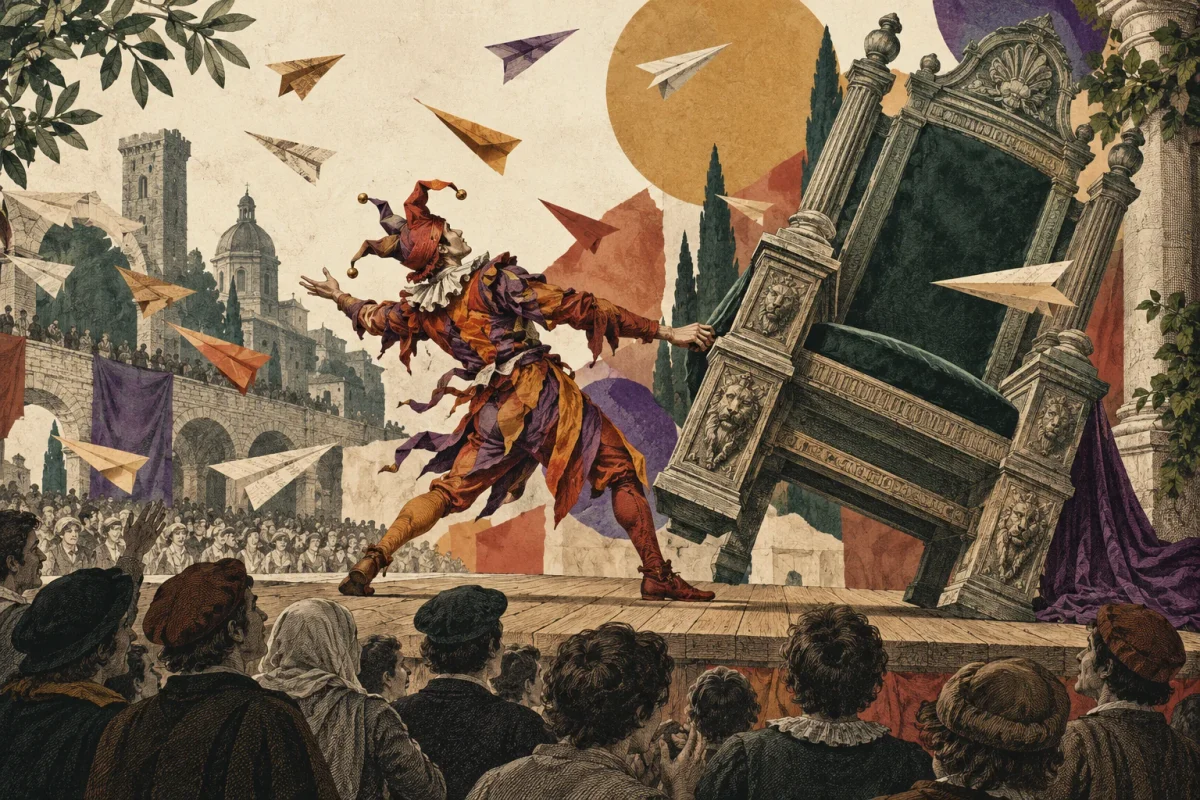
Power is also recognized by the way it organizes language. Some people can define the problem; others are called only to answer. Some tones seem naturally serious; others are classified as a disturbance before they are even heard. The jester enters this distribution of the parts with an oblique gesture.
In 1997 the Nobel Prize in Literature was awarded to Dario Fo through an explicit reference to the tradition of jesters and the dignity of the oppressed. Motivation identifies in comedy a relationship with authority, documented in the official page of the award.
The choice makes visible a tension: a form that lives even on the margins of consecrated languages enters one of the institutions that recognize them. It is a productive contradiction if it continues to generate questions. The prize does not end the conflict about what literature is; it brings that conflict to the scene.
The point is every public space. Who decides if a voice has the right tone? A laugh may show that respect is required in the form of authority while its conduct remains out of control. The comic gesture changes for a moment the perspective from which we observe.
Draw a story, make the body work
In the Nobel lecture, Fo presents images he drew and tells the value of improvisation. He recalls the storytellers and master glassmakers of his own training and indicates in Ruzzante a reference for a theatrical language capable of mixing dialects, rhythms and invented sounds. La lecture preserved by the Nobel Foundation makes this self-representation of the artist accessible.
Grammelot brings to the fore an often forgotten fact: we also understand through rhythm, gesture, situation and expectation. A sound sequence may suggest a domain relationship before the audience translates it into a proposition. The body shows the functioning of a scene.
This is where a political possibility arises. A bureaucratic speech can be recognizable in the cadence, in the repetitions, in the way of occupying the time of others. The theater exposes it as behavior. Authority loses the protection of its natural appearance and becomes something we can observe.
This operation calls for competence. To laugh is not simply to utter an absurd phrase: one must build a wait, let it mature and modify it. The public participates by recognizing the situation and completing the passage. Comedy involves a shared knowledge that the scene can also question.
Laughing Together Preserves a Question
Collective laughter, however, possesses an ambivalent force. It can free you from a fear or turn someone into a target with no chance of response. To understand the satirical gesture it is necessary to look at the concrete relationship: what power is exposed, what consequences are made visible, who bears the cost of the joke?
A critique of authority remains alive if it admits to questioning its own as well. The artist can win over a loyal audience; the audience can come to recognize itself in a repertoire of predictable enemies. At that point laughter risks confirming a belonging more than opening the thought.
The work of the jester can then be read as an unstable practice. Every new situation requires recognizing where the power has shifted and what language protects it. The repertoire retains value when it can be transformed by the encounter with the present.
A cultural journal also faces the same choice. He can use irony to make a contradiction more understandable, leaving accessible documents and arguments. Or it can replace the demonstration with a wink that only asks the reader to stand on the right side.
Fo offers a demanding track: bring back the body, the popular memory, the possibility of overturning the scene. The point is not to decree that every laugh tells the truth. It is to preserve a space in which what presents itself as untouchable must return to support a demand.