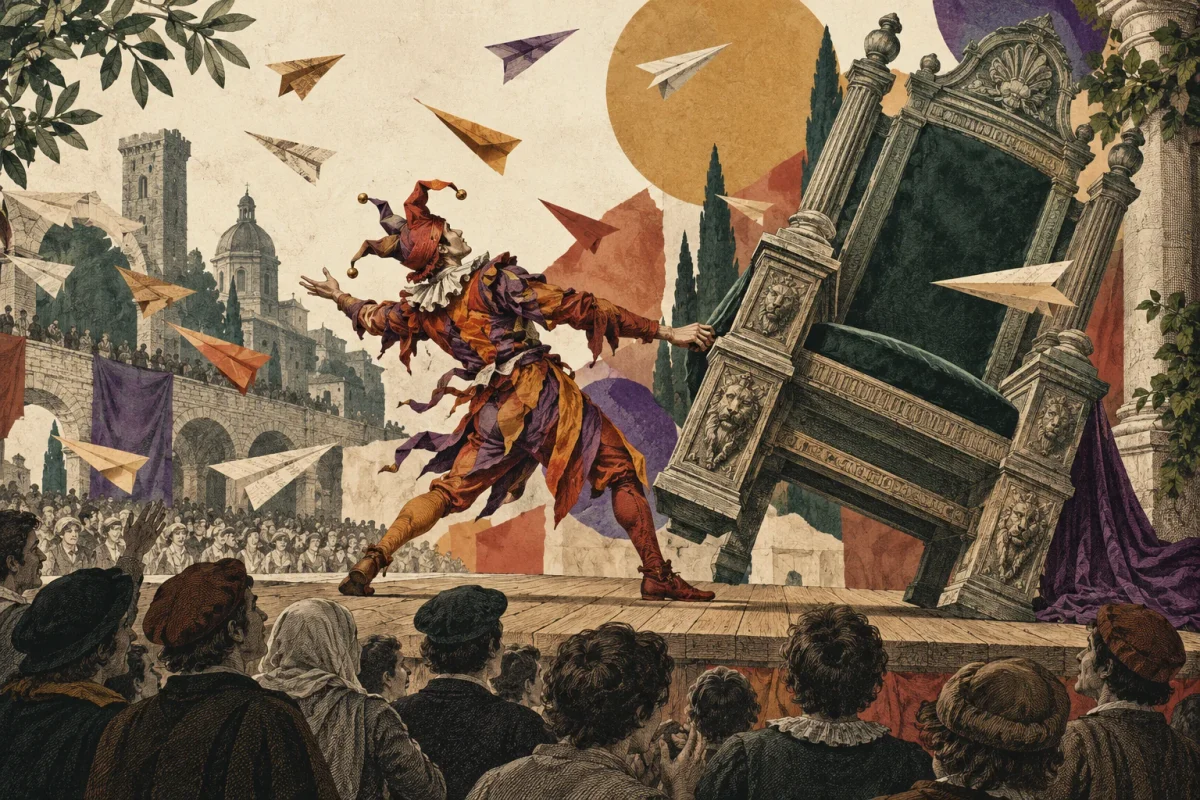
A poet bears his own name on stage
What happens when the title of a tragedy coincides with the name of the person who writes it and interprets it? In Vladimir Mayakovsky, the presence of the poet enters directly into the theatrical construction. The scene offers a place where identity becomes material to be exposed, deformed and tested.
The Majakovsky State Museum documents the December 1913 performance at the Luna Park Theatre in St. Petersburg, the main role played by the author and his participation in the direction. It also preserves visual evidence of the scene. They are verifiable points in the Museum card dedicated to tragedy.
The fact is significant without ascribing absolute primogeniture to it. The theatre has a much broader history of transformations of the relationship with the spectators. Here a precise choice is concerned: the poetic voice takes shape in front of an audience and exposes itself to the risk of encounter.
That name on the title also creates a tension. It may indicate an extreme singularity, but it asks the audience to recognize something about it. The figure of the poet lives between the exception and the possibility of speaking through a common experience. The audience must find, reject or invent their own distance.
A Mystery Transformed into a Comedy of the Present
In 1918 he appeared Funny Mystery, whose extended title presents the work as a heroic, epic and satirical representation of its own era. The MoMA preserves the Petrograd edition, with a lithographed cover that binds text and image. La object tab returns this materiality.
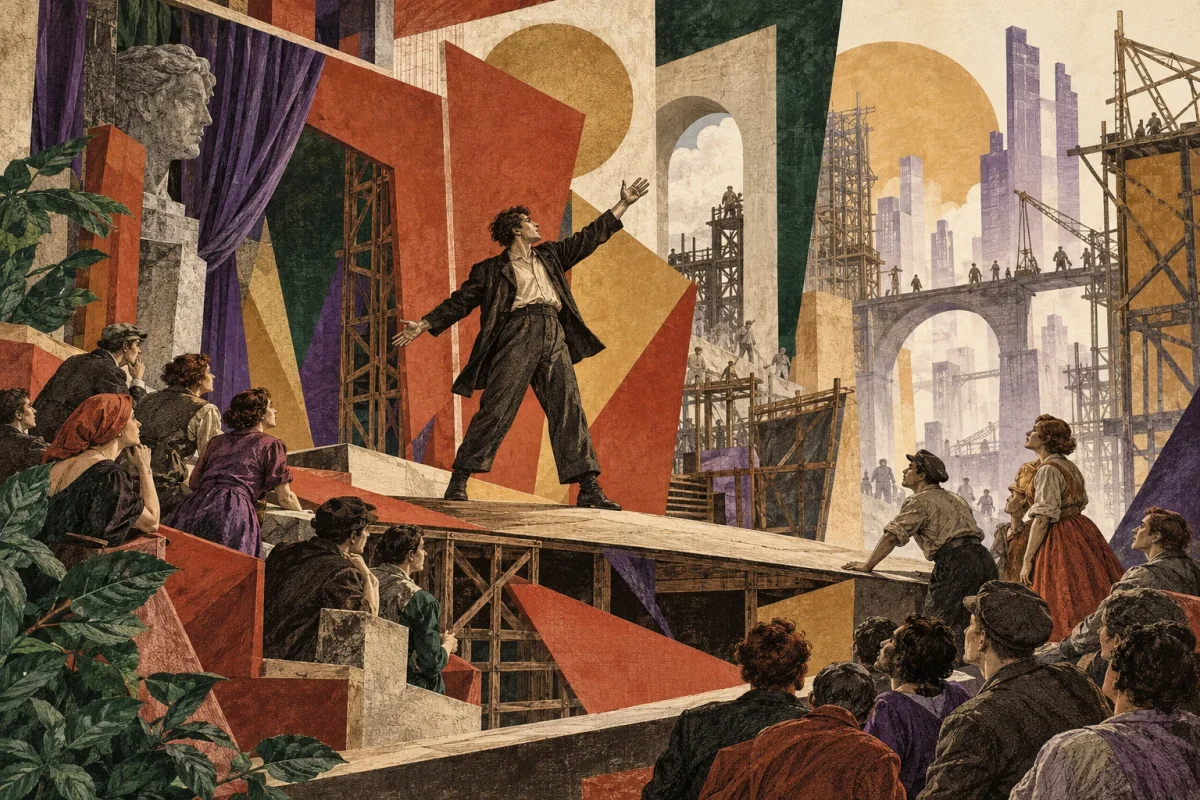
The future is not just a topic. It can enter the way you write, layout, pronounce, and distribute a text. The book and the scene become places in which to try a different relationship between word and recipient. The form participates in the vision of change.
The combination of mystery and funny also suggests an operation on inherited language. A solemn frame may be crossed by the comedian; a collective matter may be carried towards theatrical excess. The public encounters registers that are not reduced to explanation alone.
This procedure poses a still useful question. If a work wishes to speak to many, what complexity can it ask of those who encounter it? Making an experience accessible does not always coincide with making it familiar. Sometimes the new form requires learning, a willingness to find concrete opportunities.
Who has the right to imagine the new
The vanguard contains a promise and a problem. The promise consists in the possibility to stop considering the present order inevitable. The problem arises when a language that wants to open the future decides in advance what future others should recognize.
The relationship with the public therefore remains decisive. Is the viewer summoned as a participant or as proof of the success of the work? Is dissent a material to be understood or just a delay to be corrected? A scene that transforms conventions can reproduce hierarchies in the way it judges the viewer.
Reading Mayakovsky today allows you to keep this tension visible. The strength of an artistic gesture is not measured only by its distance from the past. It also counts what makes possible after the impact: other words, other images, a greater ability to participate in the construction of meaning.
A contemporary project can learn from the materiality of those works. The future takes shape in minute decisions: the layout of a page, the relationship between voice and image, the moment in which space is left to an answer. Innovation gains consistency through these choices.
The most difficult question remains open: how to produce a new form that can be inhabited even by those who do not recognize it immediately? The theater doesn't have to solve it once and for all. It can make her present, in front of bodies and gazes that share for a time the same scene.