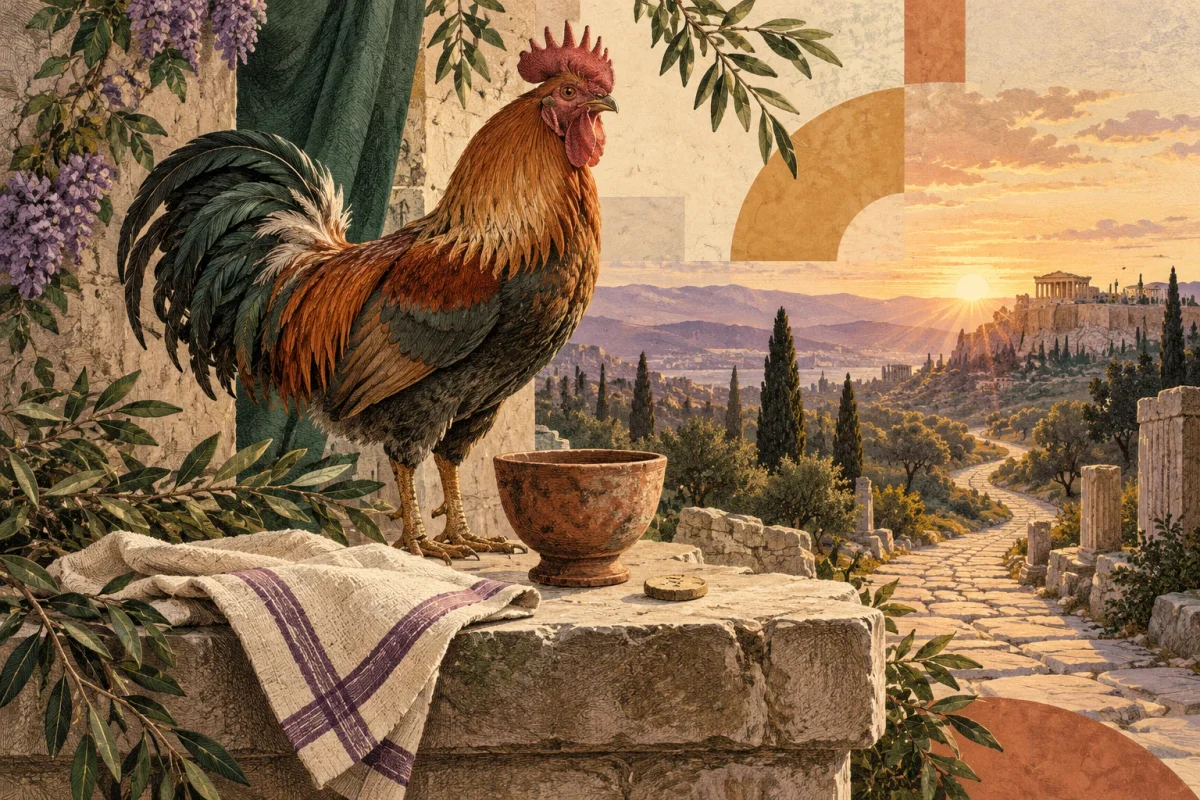
At the end of the Phaedon, when Socrates' body is yielding, a debt remains to be paid: a rooster to Asclepius. The disproportion affects. A dialogue on death and the soul ends with a concrete assignment entrusted to Crito. The detail does not close the sense of the scene. It reopens, because it forces one to ask what it means to remain present in one's relationships while everything seems to become definitive.
A phrase that is not allowed to be consumed
The reference is Fedone, 118th. Asclepius belongs to the cult of healing and the rooster is an offering. A famous reading is born from this association: leave would thank for a release from bodily life. However, the text also allows one to consider a concrete religious obligation, the antecedent of which is not explained. The existence of different interpretations is part of the problem, not a defect to be corrected with added certainty.
We can also observe the structure of the scene. Socrates does not make a successful assessment; he instructs someone to complete an action. The last word is still a link. Philosophical greatness and small daily responsibility are put in the same field of view.
It is a possible reading, not the conclusive decipherment of historical intention. Dialogue is a work of Plato: we meet Socrates through a literary and philosophical construction, not through the recording of his last hours. Keeping this mediation in mind makes the question of what that scene has continued to communicate more interesting.
When Reasons Meet the Cost
Nel Crito, the friend proposes to Socrates an organized escape. The discussion shifts the criterion from immediate convenience to justice of action. The Laws of the city take a voice and question the relationship between the life spent in Athens and the possibility of escaping condemnation.
It does not follow a simple rule that every law should be accepted under any circumstances. The dialogue stages a precise topic, with questionable premises and serious consequences. Reading it today means being able to examine those reasons, not just admire the firmness of those who pronounce them.
Consistency thus becomes something more demanding than the repetition of a position. If new information emerges, changing judgment can be a form of responsibility. If we change only because the price has gone up, we must at least recognize the passage. The difference is seen in the willingness to explain which reasons remained valid and which were abandoned.
This need concerns a public choice, a personal promise, a shared job. We can declare a principle until it produces consequences; when it encounters an interest, we discover how deep-seated it was and how much it was a way of representing us.
The risk of turning an example into a cult
The image of Socrates can become so monumental that it prevents us from thinking. If consistency is identified with extreme sacrifice, every hesitation appears a weakness and every revision a betrayal. One loses the very job of questioning that makes philosophy alive.
The rooster allows another attention. A commitment has recipients, circumstances, and content. It is not enough to feel faithful to one's own image; it is necessary to ask who will suffer the consequences of our choices. A promise kept may be fair, but it may also prolong an error. His evaluation requires a look that includes others.
That is why the final scene can accompany a very ordinary question: what have we left to someone to do, and have we recognized him? Responsibility does not live only in solemn moments. It appears in the returns, clarifications and debts we avoid naming.
The reader does not have to choose between worship and disqualification of the character. He can pause in the restlessness of dialogue, discuss the relationship between law and justice and finally return to that small assignment. Even a thought about the destiny of the soul meets the concreteness of a relationship not to be left unfinished.