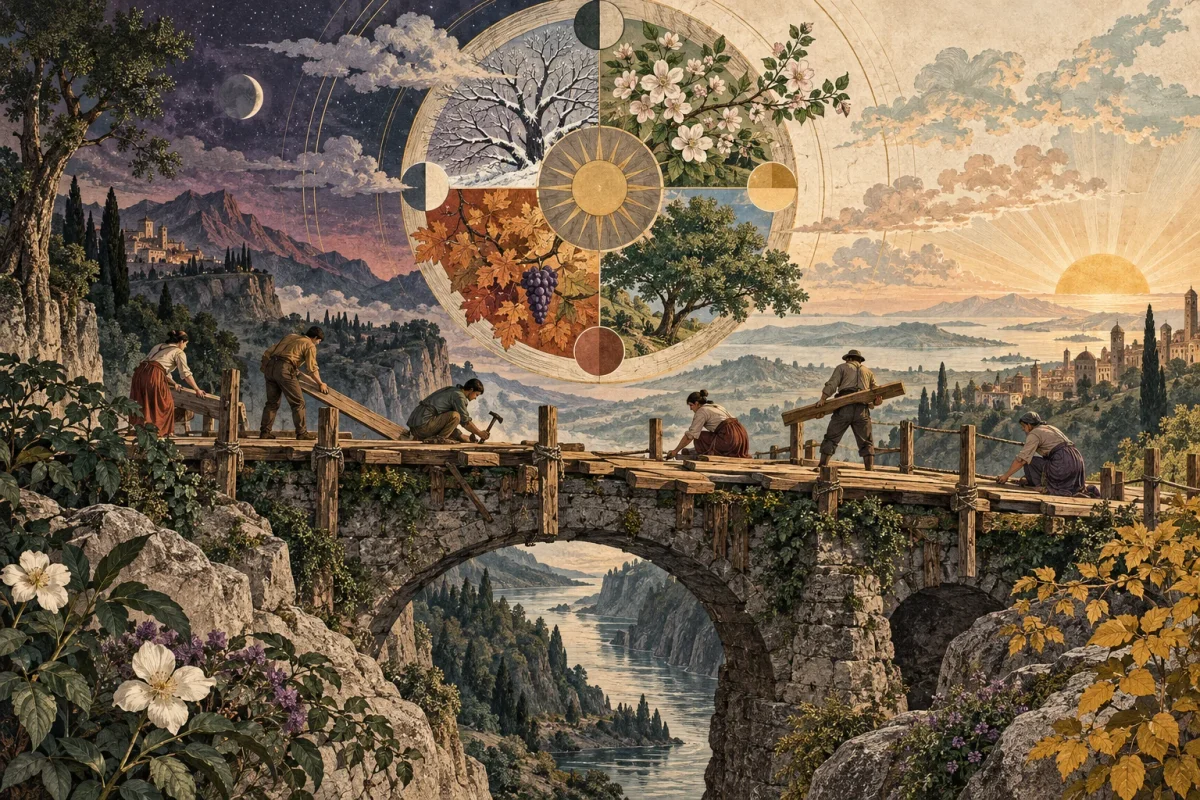
An hour can pass without a trace or become the center of a day. The clock assigns her the same measure. The way we live it contains expectation, attention, effort and encounter. An important conversation is enough to realize that the duration also has a quality.
Societies shape time through calendars, recurrences, and rituals. A date makes appointments and exchanges possible; it can also preserve a common memory or interrupt the ordinary course of the week. Questioning the calendar means wondering what life we are organizing with that form.
More than a way of counting
The Smithsonian's Living Maya Time project features several components of Mayan calendar systems, including Haab, Tzolk'in, Calendar Wheel, and Long Count. Cycles have practical, historical and ceremonial functions. The page also includes the perspective of a keeper of the k'iche' time, remembering that this knowledge belongs to living cultures.
The calendar is therefore not just a sequence of boxes. It relates astronomical observation, collective life, and symbolic values. The same community can use different cycles for different functions. This plurality invites us to observe our relationship with dates without reducing a tradition to an exotic formula.
A birthday, a sowing, a holiday or a commemoration make visible something that an isolated number does not contain. Establishing a day means paying attention to an event. The editorial question is simple: what does it find place in our calendars, and what remains constantly out?
The Day Out of Time
José Argüelles has developed a contemporary proposal linking calendar, art and transformation of consciousness. The Foundation for the Law of Time presents July 25 as Day Out of Time, a day dedicated to collective celebrations and practices. The 2011 document exposes the link with peace, tolerance and willingness to serve.
This reference allows one to know the content of the proposal and the spiritual vision of the movement. The relationship with ancient Mayan calendars requires another reconstruction: contemporary design and historical systems do not become equivalent because they share symbols and inspirations. Distinguishing paths helps to better understand both.
The image of a day out of time remains suggestive even on the level of experience. It introduces a deliberate interruption: a day in which the value does not coincide only with the amount of activity completed. In that pause, art and encounter become a way of attributing meaning to duration.
The haste as an organization of the world
Let's look at an ordinary agenda. Work commitments are often precisely defined; rest and care are left at intervals. A friend, a landscape or a thought still formless must adapt to what is left. The distribution of time tells a hierarchy even when no one has formulated it explicitly.
This does not mean that a life can do without deadlines or obligations. However, we can ask ourselves what criterion holds them together. A fully occupied day can be rich or fragmented. The order of the boxes does not alone reveal the quality of the relationships we have gone through.
Shared time also needs attention. A periodic meeting can become an automatic repetition or a place capable of interrupting habits. The difference depends on what happens during the meeting: do we really listen? Do we let something emerge that wasn't already planned? A recurrence comes to life when the gesture manages to meet its meaning again.
A Calendar to Question
Changing pace can begin with a limited choice. Give a name to a reading time, make room for a meeting without a result to be produced, write down what made a day different. They are daily possibilities, to be adapted to your situation and the responsibilities that go through it.
The value of a ritual can be found right here: in the relationship between a repeated form and renewed attention. If the shape absorbs everything, it remains a deadline. If it supports experience, it can become a reminder of what we want to cultivate.
The question of inner time does not purport to replace the clock. He asks what dimensions of life he cannot represent. A calendar can coordinate the world and, together, invite you to stop. It also depends on which meetings, memories and possibilities we choose to make visible in its pages.