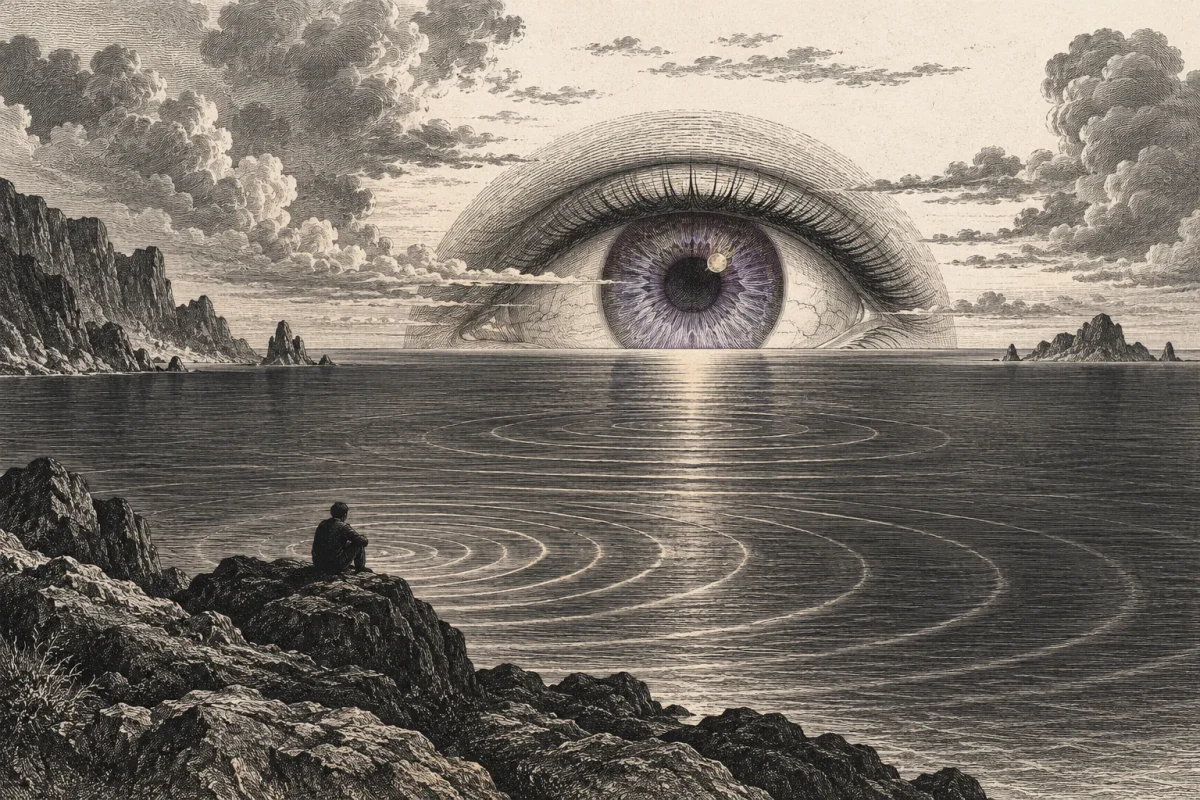
The Weight of a Question
To imagine that you can start over seems to offer a liberation: to change a choice, to avoid a mistake, to say a word that has remained unexpressed. The eternal return proposes a more difficult experiment. What would happen if the same life returned, in its details, without the possibility of correcting it before living it?
In Aphorism 341 of the Gaia Science, Nietzsche presents this perspective through the appearance of a demon. The story questions the person's reaction: despair or ability to still desire what has been experienced. The text of the work allows to meet the question in its narrative form.
The scene does not deliver an experimental result on the workings of the universe. It brings time into the inner life. Repetition makes the relationship with what we are doing now visible, including the moments we liquidate as simple steps to a finally important future.
The present thus acquires a different density. If a gesture were to return, how would we live with it? The question can illuminate a continually postponed promise or the time spent sustaining an image of us in which we no longer recognize ourselves.
The Circle and the Enigma
In Thus spoke Zarathustra, the chapter dedicated to vision and enigma again stages the return through figures and dialogues. The encounter with time does not end in the assertion that everything is a circle. The chapter of the primary work preserves the tension between idea, image and experience.
This writing choice counts. A thesis that we could repeat in a few words is transformed into a path. The reader must face the weight of demand, as well as recognize its name. Philosophy also goes through what an image can get us to support.
The return may appear as a loss of freedom: if everything repeats, what place remains for choice? Read as existential proof, however, it shifts attention to the quality of action. The question is how present we are to a life that no one else can fully assume in our place.
This does not dissolve material conditions. A person does not have all the alternatives the same way. The possibility of asserting one's existence cannot be used to deny injustices, dependencies or need for help. Thought becomes more demanding when it meets these limits.
Affirming doesn't mean approving everything.
The idea of saying yes to life risks becoming an aggressive formula if it is imposed on those who suffer. A painful experience does not automatically make sense because someone claims to accept it. The time it takes to understand it belongs to those who live it.
The question of return can instead be addressed to oneself as an exploration. What moments would we want to fully inhabit? What gestures do we repeat without actually choosing them? What part of our time is delivered to a wait that never meets the present?
Regret can also change function. It can become a closed room, where we endlessly rebuild an alternative past. Or it can help us recognize a current responsibility: a relationship to be cared for, a limit to be set, a decision we don't want to keep putting off.
It is not necessary to want every event to happen again in order to learn something from the experiment. Resistance itself can show where a question is concentrated. The important thing is to let it produce attention, instead of turning it into an examination in which we must be strong enough.
Nietzsche brings the future and the past into a present we can't just jump into. Life is not just what we tell once a phase is over: it understands the way we wait, listen and act today. The return makes this experience more difficult to consider provisional.