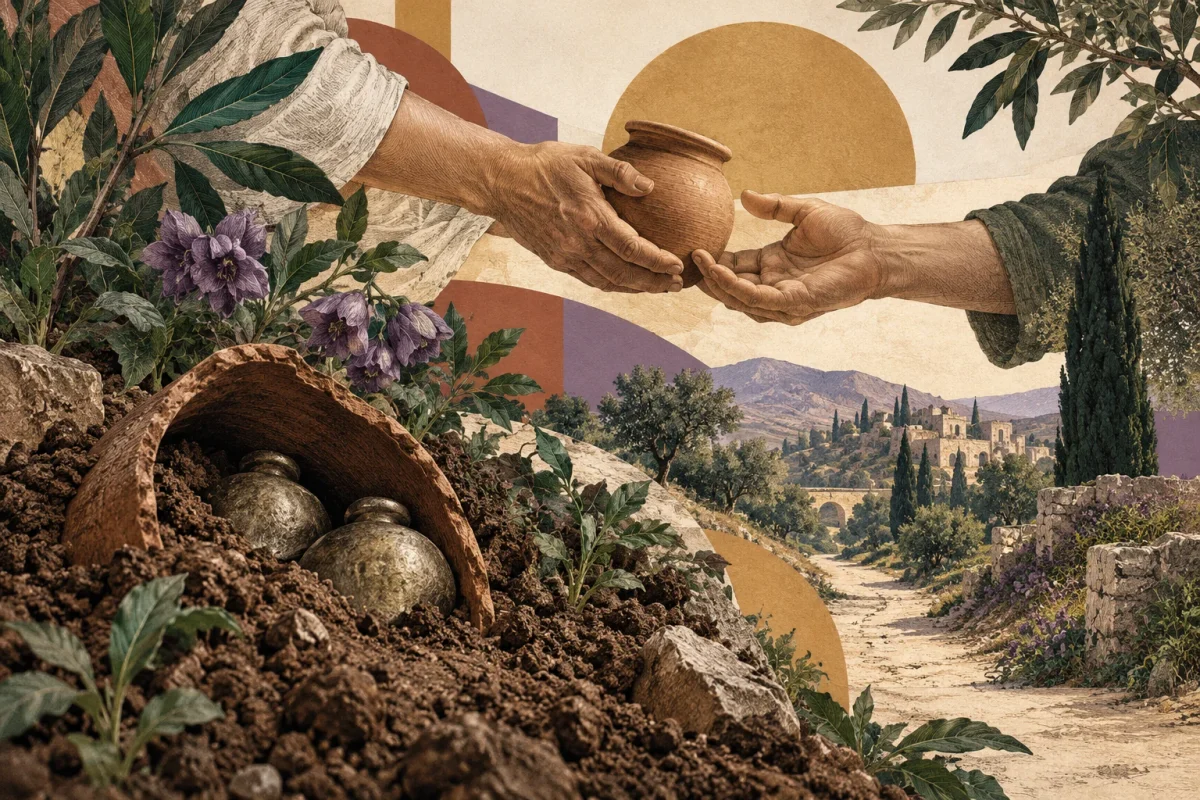
The third servant returns everything. He did not lose anything, he did not consume the assets received, he did not even risk ruining it. Yet in the parable he is harshly rebuked. The talent scene thus resists the reassuring reading that it is enough to preserve what has been delivered to us. But it also resists its transformation into a simple command: to produce more and more, whatever happens.
Before Capabilities, Assets Trusted
Nel Chapter 25 of Matthew, talents are monetary goods. The distribution is different: five, two and one, according to the abilities of the servants. The first two double what they receive and get the same approval; the third hides its part underground.
The detail prevents the story from being reduced to a race over the absolute result. Those who start from two do not have to get to the amount of those who start from five to receive recognition. Spiritual reading that associates talents with personal gifts is an interpretive passage, not the initial material meaning of the word.
The servant who does not act explains his choice through the fear of the master. The ratio then precedes the yield. We can ask ourselves what is entrusted and, together, what image of the one entrusted makes it possible to take responsibility for it.
This question does not render the hardness of the finale harmless. The punishment remains in the text and deserves to be addressed, rather than removed to build a motivational fairy tale suitable for any situation.
Trust and fear change the field of action
NelAngelus of 19 November 2017, Pope Francis interprets the parable through the image of God: the fear of a severe master blocks the servant, while trust opens to responsibility. It is a declared contemporary Catholic reading, which does not exhaust the exegetical possibilities of the story.
His question can also go through daily experience. Does entrusting a task mean allowing a margin of initiative or demanding an outcome without offering freedom? The demand to dare changes sense if every mistake produces humiliation.
There is no need to use religious text to diagnose organizations. It is enough to recognize a tension: we cannot ask for creativity and at the same time build relationships in which every deviation is punished. The person can choose to protect himself through inaction, even when he has resources.
This observation does not eliminate individual responsibility. Prevents isolating it from context. If we want to understand why something remains buried, we must look at both the gesture and the relationship within which that gesture is carried out.
Differences between stories prevent slogan
La Parable of the Mines in Luke 19 contains a different set-up: a nobleman who seeks royal power, opponents and an explicit political context appear. It is not correct to freely join the details of the two stories as if they were one sequence.
The comparison also shows how risky it is to extract a ready-made economic rule from Scripture. Money, power, and judgment are part of the narrative; moving from these elements to a general business model would require other arguments.
Instead, we can question the contemporary use of the word talent. It often indicates a quality to be exhibited, measured and put into competition. In the Gospel account the good is received: the person is not the self-sufficient origin of what he possesses. This difference opens up a question of gratitude and the destination of what we know how to do.
A gift cultivated only to prove superiority can remain poor in relationships. A modest ability can become important when it meets a precise need. The question that the text leaves to work is not just how much we have managed to multiply. It is about how we have responded to what has been entrusted to us, and the conditions we offer others so that they can do the same.