The crowd is hungry. Before becoming an image of abundance, the account of the loaves and fish meets this material condition. Someone has to recognize it, someone asks how to answer it, someone looks at what is available and finds it insufficient. Spiritual reading can begin right here: from the need that interrupts the program and forces a relationship to take shape.
The little is looked at closely
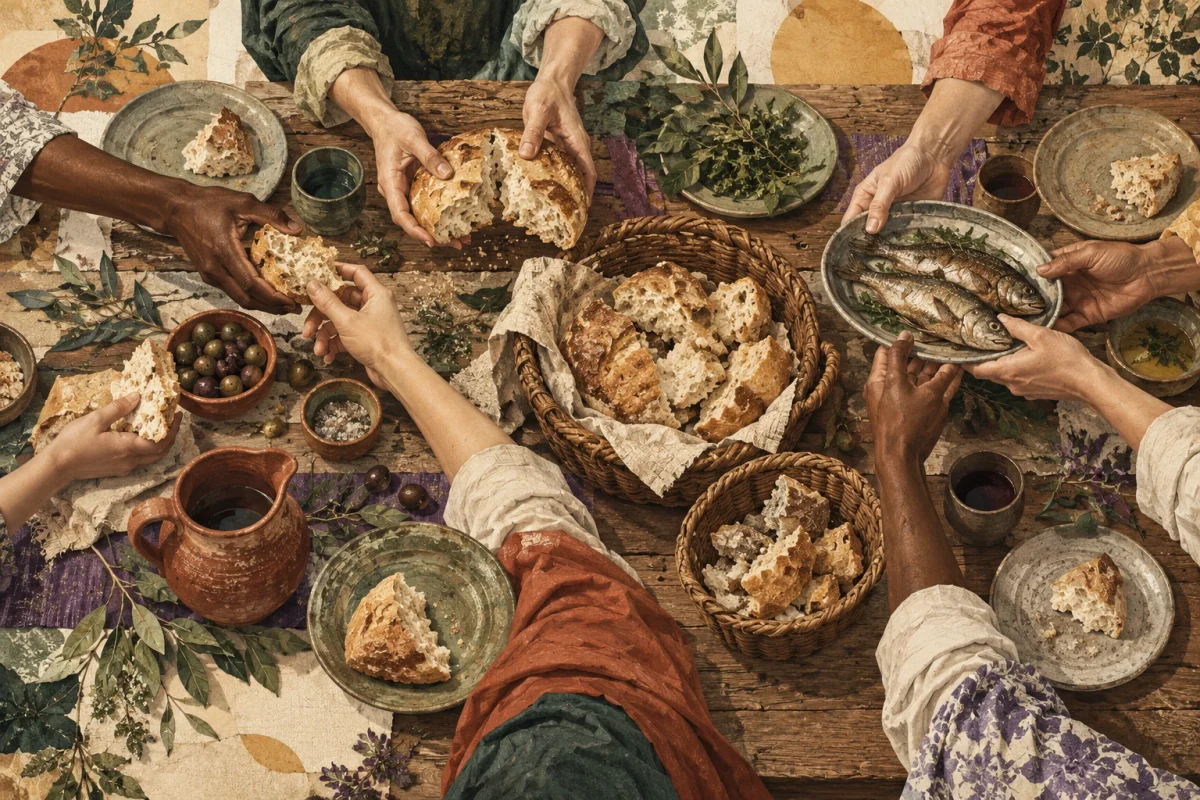
Nel Chapter 6 of John, Andrea reports a boy with five barley loaves and two fish. The little therefore has a concrete provenance in the story. It is not just an abstract quantity to compare with the number of people.
After the crowd has been satisfied, the fragments are collected. The text links abundance to the care of what remains: having more than necessary does not automatically authorize one to consider the rest irrelevant. The gesture expands the scene beyond the spectacular moment.
The Gospel presents the event as a sign. A cultural reading can question gift, distribution and responsibility without claiming to demonstrate a physical mechanism of multiplication. There is also no need to erase the miracle from the text, replacing it with a social explanation and presenting it as the only true one. The plan of faith, that of literary analysis, and that of empirical proof ask different questions.
For those who read today, the boy opens up a simple problem: do we recognize resources that come from people without authority? Or do we see only what comes from an already legitimized position?
The need also modifies the program
In Mark 6, the story opens with the return of the apostles and the invitation to rest. The arrival of the crowd changes the course of the scene. In the face of hunger, the disciples propose to dismiss people so that they can get food. The answer directly involves them in the distribution.
The text does not only feature a benefactor and an indistinct set of recipients. There are intermediaries, space organization, people sitting and food passing by. The report includes a concrete dimension of care, not just the intention to do good.
This structure can illuminate a public issue without becoming a ready-made administrative model. When we say that a need is too great, are we describing a real limit or avoiding questioning the possibilities available? The distinction requires data and responsibility, not just enthusiasm.
Sharing does not erase scarcity in every situation. However, it can change the way we read it: as a problem to be fully downloaded on those who suffer from it or as a condition that also concerns those who have a part of the resources.
The gift must not ask for a crown
In John, after the sign, the crowd wants to make Jesus king and he retreats. Abundance therefore also opens up a question of power. Responding to a need can generate recognition; that recognition can become a claim to government or an addiction.
The point is not just about individual generosity. An aid publicly offered builds images and reports: who appears as the protagonist, who remains anonymous, who has to thank and for how long? The communication of the gift can restore dignity or focus all attention on the greatness of the giver.
It is a question to be addressed even to sincere gestures. The goodness of intention does not automatically make conditions irrelevant. Can the recipient refuse a photograph, discuss the form of the aid, continue to disagree with the benefactor's ideas? The freedom of the recipient makes visible the type of relationship that is being built.
The Gospel account thus leaves more than an image of multiplied resources. He brings to the same field hunger, participation, fragments and a rejected crown. Shared bread can feed without transforming itself into the price of obedience: this possibility continues to question our way of giving.