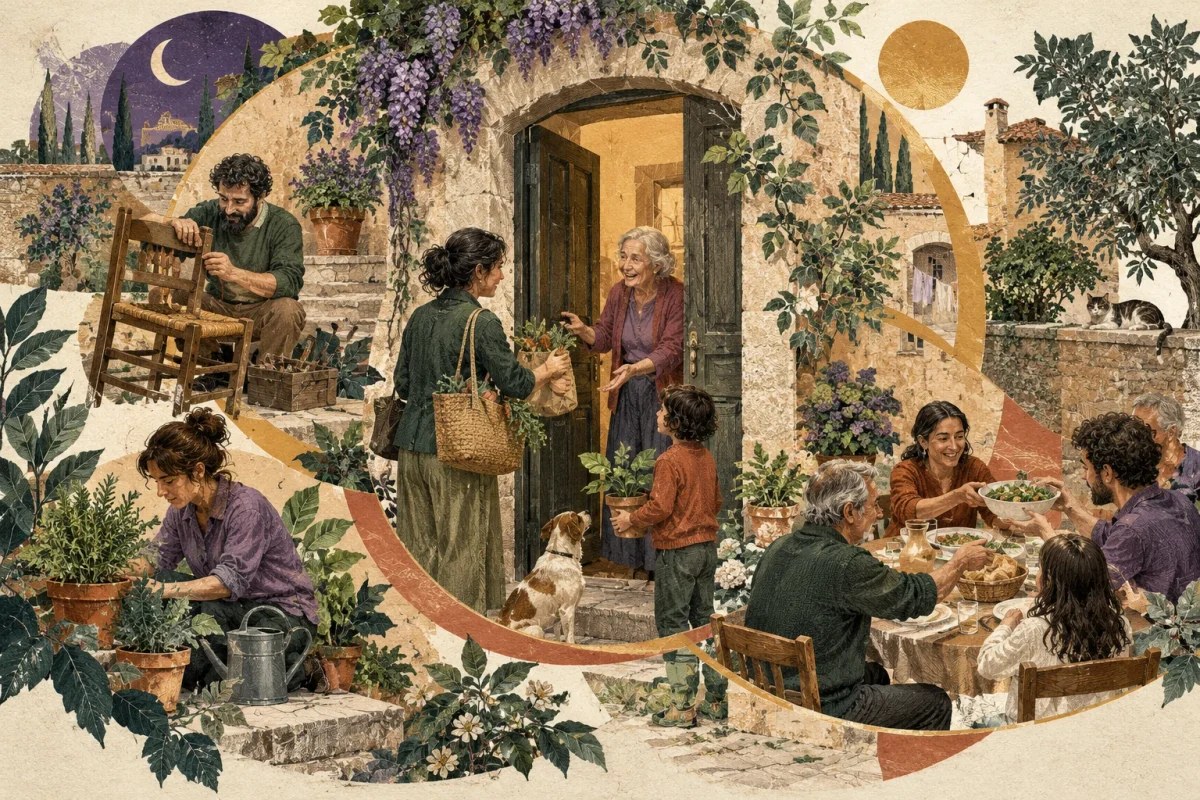
A house to be arranged, a visit to be arranged, a bill that has no place in the family budget. Often the need has ordinary dimensions, while loneliness makes it unsurpassed. Let's imagine then a community that, every month, focuses a part of its attention on a person or family: time, skills, listening and material help collected together.
It is a proposal to be designed, not the account of an already existing program. Its strength lies in shifting the focus from isolated intervention to the quality of the relationship. Its most delicate point is to prevent the recipient from being reduced to a case to be handled or feeling obliged to expose their life.
The need defines him who lives it
The first meeting should serve to understand what a person really wants to share. We can be ready to repaint a room while she needs someone to listen to a difficult decision. Or we can offer words when we need hands, a car ride, or administrative expertise.
That is why consent is also about the way of help. Entering a home, raising money, communicating a difficulty to others are actions that touch on dignity and confidentiality. Participation can remain free at any time: accepting a visit does not mean accepting any subsequent intervention.
The United Nations Volunteering Report 2022 also describes volunteers as contributing to decisions and building relationships between communities and institutions. Attention to participation offers a useful criterion: those who experience the problem must be able to help define the answer. UN Volunteers, State of the World’s Volunteerism Report.
Reciprocity Has Different Times
A system of mutual help does not require that every gift be returned immediately to the same extent. In some periods we have energies to offer; in others we depend more on the availability of others. Thinking reciprocity over a longer time allows us to recognize this variability without assigning fixed identities to the giver and recipient.
We can imagine a sustainable calendar: few activities agreed upon, people responsible for following them and a final moment to listen to how they were lived. The following month, the focus and tasks change. Relationships remain, along with the possibility of continuing some support when needed.
Elinor Ostrom's research, recalled by the Royal Swedish Academy of Sciences in the 2009 award, shows that user associations can successfully manage common resources. It does not automatically prove that any community works. He invites, however, to study the organization of cooperation, instead of considering it impossible to start with. Royal Swedish Academy, reasons for the award.
The cure needs boundaries
A shared fund requires understandable criteria and reporting. A professional service requires appropriate skills. Voluntary availability requires time limits that also protect those who offer it. These practical aspects give substance to an intention that otherwise risks being consumed in initial enthusiasm.
Above all, the freedom to say that help did not work. A community grows when it can correct itself without interpreting dissent as ingratitude. Giving up an intervention can also be a respectful decision, if it emerges that it does not respond to the need or exceeds the available possibilities.
The proposal of a month of attention thus becomes a question addressed to each one: what resources do we possess that remain unused because they do not meet those in need? A meal, an hour, a trade, a presence can change meaning when they enter into a chosen relationship together.