The question before the image
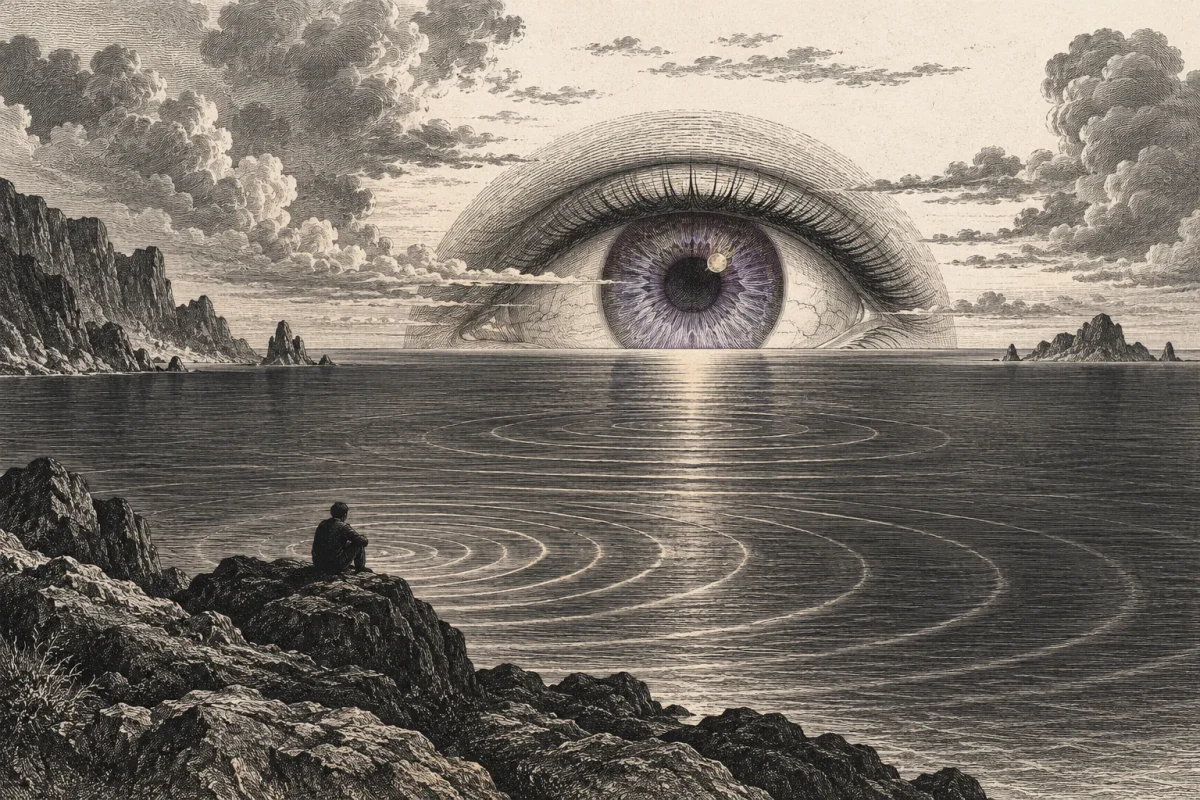
When we look at a tree, where does what we call experience take shape? In the object, in the brain activity, in the relationship between both? Jacobo Grinberg-Zylberbaum took this question beyond the question of how we represent the world. His proposal sought the passage in which nervous activity and lived reality become a single event.
In the contribution published in 1997 in the Journal of Mind and Behavior, the researcher presents a neuronal field generated by the interaction between elements of the brain. The field, according to the model, modifies a fundamental structure of space-time; the perceptual experience would be linked to this interaction. It is a strong thesis: consciousness participates in the constitution of the experienced world. The article exposes it as a set of postulates to be linked to psychophysiological research. Grinberg, original 1997 article.
To take this possibility seriously is to ask for precision. The lived world includes colors, emotions, memories, meanings: the fact that a perception changes with the observer opens up a real problem. The further leap, towards the transformation of the physical structure of reality, instead requires observations capable of distinguishing that model from competing explanations. They are related questions, with different evidence.
The report enters the laboratory
An experimental 1992 work, signed by Grinberg and collaborators, describes couples of people who had established direct communication. They were then separated into electromagnetically shielded chambers and kept in the dark. The authors report that the stimulation of one person corresponded in the other an electrophysiological signal, interpreted as transferred potential. The publication argues that the result is compatible with syntérgical theory. Original studio.
The experimental question is fascinating: can a correlation emerge between people when the usual sensory channels are excluded? Screening controls, instrument synchronization, signal selection criteria, statistical analysis, and independent repetitions are required to evaluate it. A striking graphic, alone, does not allow to choose between transfer, artifact and coincidence.
Even a repeatable result would need a second step: to explain the mechanism. An observed correlation does not automatically prove that two brains are bound by quantum entanglement. This prudence belongs to the research itself. It protects the question from the habit of using a prestigious word as a ready-made answer.
Pachita and the strength of the witness
The case of Pachita brings the problem out of the lab. In the book dedicated to the healer Bárbara Guerrero, Grinberg describes the operations and body transformations he interpreted through the relationship between the neural field and the latex. The editorial presentation of the work explicitly reports on transplants and interventions on the subject: the extraordinary content of the story must therefore be addressed in its entirety. Pachita, Penguin edition.
A witness can be accurate, sincere, and deeply transformed by what he sees. However, sincerity does not automatically produce a medical record, an anatomical match, or a comparison before and after. Here the decisive boundary opens: the book also documents the way a researcher understands experience; the verification of a cure requires documents that allow others to control its outcomes.
To ascertain a transplant would require, for example, previous diagnosis, tissue identification, subsequent verifications and an independent reconstruction of the procedure. To talk about cancer remission would require a confirmed diagnosis and the course of the disease over time. The word healing contains a commitment to the concrete body of the sufferer.
A theory to inhabit and interrogate
The quest for consciousness loses something when it is closed in two automatic answers: total adherence or rejection before reading. There is a more challenging space: understanding exactly a proposal, preserving its ambition and verifying each step with the relevant tools.
Latex can be studied as a hypothesis about the structure of reality and as an image that invites to recognize interdependencies. The two uses can dialogue, as long as it is clear when we are formulating a measurable prediction and when we are working on the meaning of experience.
For those who read, the question remains close: how much of the daily reality do we encounter and how much do we repeat through perceptual habits? We can observe this relationship without ascribing clinical powers to it. The value of Grinberg's work also lies in the tension he leaves open: a conscience capable of questioning its own limits must be able to question even the evidence that would have them overcome.