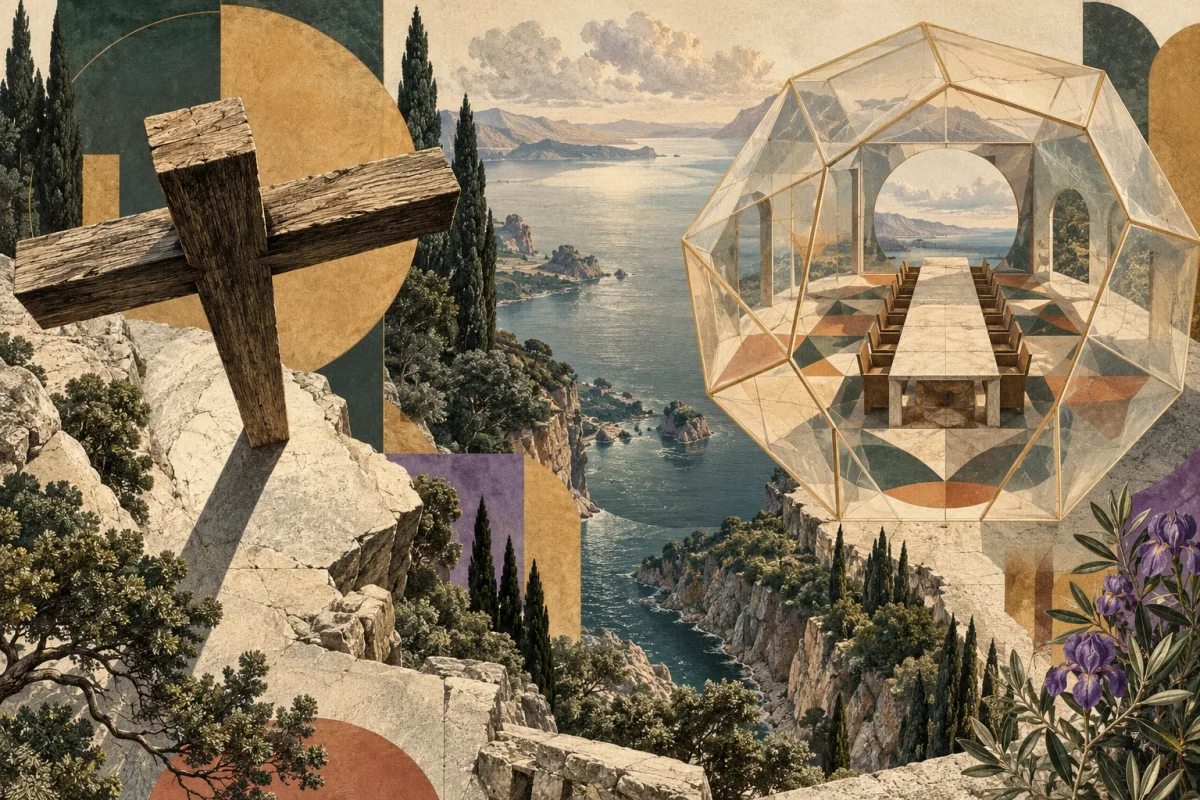
A familiar image can become strange without changing the subject. In the Christ of St. John of the Cross, Salvador Dalí brings us over the crucified figure. In the Sacrament of the Last Supper, the table is placed within a transparent geometric structure. The recognizability of the subject remains; it changes the place from which we can meet it. The artistic problem arises in this shift, before any explanation of the symbol.
The Body Observed from Above
La Glasgow Life 's It identifies the painting of 1951 and reconstructs the reference to a drawing by Giovanni della Croce. It also connects the project to Dalí’s nuclear mysticism, in which Catholic faith and scientific imagination are joined. the The Gala-Salvador Dalí Foundation it documents material data and location.
The view from above subtracts the figure from the usual position of a frontal encounter. As a visual reading, we may wonder whether distance favors contemplation, disorientation, or an impression of power. There is no need to assign a unique response to viewers: the shift produces a space where responses can diverge.
The reference to the atom belongs to the artistic research and intentions of the author. It does not demonstrate a physical correspondence between Christ and an atomic nucleus. The work relates languages that occupy different fields in cultural life, without becoming a laboratory test.
Precision on this point helps to see the painting better. We can question his imagination without asking him to support a scientific theory that is not his object.
A Dinner Inside the Number
Nel Sacrament of the Last Supper of 1955, the National Gallery of Art recognizes a dodecahedral structure and a symmetrical organization. Geometry recalls the number twelve through apostles, solid faces, and other cosmic references. The museum presents the scene as symbolic construction of the Eucharistic rite, rather than documentary reconstruction of the meal.
The transparency of Christ’s body and envelope makes the boundary between material presence and vision uncertain. Bread and wine offer a more tangible reference. The question of what is present is thus inscribed in the very matter of representation.
To describe the scene only as a futuristic environment is likely to leave out this tension. The form is not an interchangeable background: it decides how the gesture can be perceived and what associations are made available.
It is useful to distinguish the identification of the structure from its interpretation. We can recognize a dodecahedron, documented by the museum board, and then discuss what that geometry does to our gaze. The first step narrows the arbitrariness; the second returns openness to reading.
The image must not become a mandatory diagram
The temptation to explain each element with a definitive key can make a work mute. If a form always means one thing, the viewer ends up looking for the already planned solution instead of meeting the tension of the picture.
These paintings allow another experience: observing the relationship between order and estrangement. Construction is rigorous, but it does not eliminate uncertainty; it can even make it more intense. What seems perfectly organized continues to ask questions about presence, body and distance.
We can look at a religious work through faith, historical knowledge, or aesthetic sensitivity. Positions must not be confused, nor hierarchized in advance. A shared image can become the place where differences become perceptible.
The most fruitful gesture may be to return to the point of view. Where are we looking from, and which part of the scene is hidden from us? The same question applies to political, advertising and everyday images. Dalí makes it hard to ignore: even when we immediately recognise the subject, we have not yet understood the position the image assigns to us.