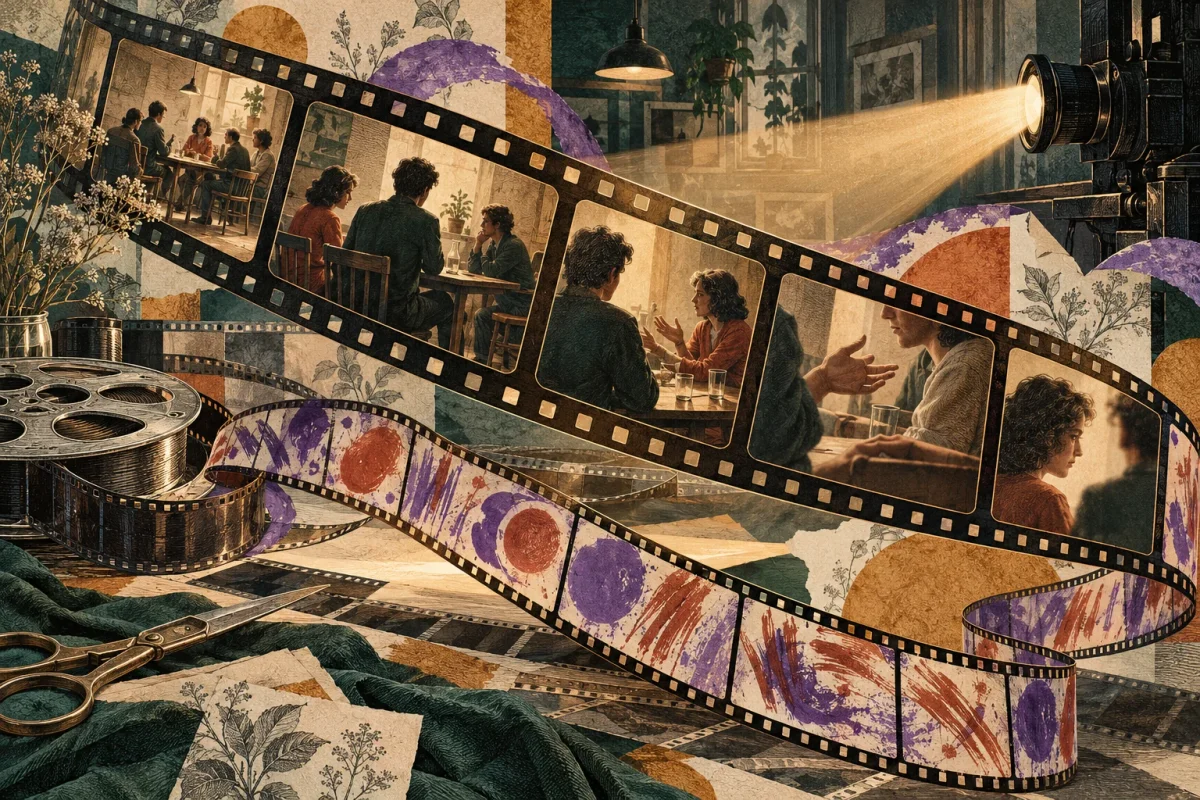
Let's imagine a shot of a table around which some people talk. The same scene can become intimate, threatening or comic through a different duration, a cut, the sound that accompanies it. Meaning takes shape in the relationships between the elements.
Cinema makes this work particularly visible. Each image shows something and leaves something out. Each siding suggests a continuity or fracture. Observing these choices also allows us to question the sequences that make up our daily experience.
Assembly Builds a Relationship
Sergei Ėjzenštejn devoted an important part of his reflection to the relationship between the frames. In the wisdom Methods of Montage distinguishes ways of organizing duration, rhythm and tonality, following tensions and passages. The author's text preserved on the University of California, Irvine website Allows you to read the reasoning.
From this research we can derive a critical exercise: looking at the fitting in addition to the single figure. A face followed by a crowd proposes a relationship; a crowd followed by an empty room suggests another. The film orients the encounter through an order.
This does not allow for an identical reaction to be predicted for each viewer. However, it makes the question of formal choices concrete. What element prepares the waiting? When is information offered? What duration allows us to notice a detail?
The same look can accompany a news service or a shared video. A complete sequence and an isolated fragment offer different conditions for understanding what happened.
When sound and color search together
In 1949 Norman McLaren and Evelyn Lambart made Begone Dull Care for the National Film Board of Canada, working directly on film with painting and engraving, in relation to the music of the Oscar Peterson Trio. La manufacturer's card technical documentation, authors and date.
The McLaren notes on workmanship describe a collaboration in which visual ideas and musical improvisations were influenced. The music was measured and reported in a scheme to organize the work on the film.
The example shows how a form can arise from an encounter between languages. Technical precision makes the invention workable; the unexpected musical can open another visual direction. Creativity grows within this reciprocity.
One spectator can choose to follow the rhythm, another the matter, another the relationship between waiting and acceleration. An abstract work thus offers a ground for talking about what we have perceived without having to start with a shared plot.
A laboratory for our eyes
Using art as an instrument of consciousness means making the way we encounter forms observable. We can ask ourselves which passage held us back, which association was born, when we stopped looking to begin to interpret.
Exercise acquires depth if it accommodates different responses. An image can evoke calm and restlessness in different people. The comparison makes it possible to recognize something of the relationship between work, memory and situation, without assigning the artist absolute control of each reading.
Even producing a short film can become research. Taking the same place from two positions, leaving an ambient sound, changing the order of the scenes: each choice makes a possibility of telling a story perceptible. Showing versions and discussing differences returns an active role to the audience.
The artistic experience can have spiritual significance for those who live it, opening up questions about presence and connection. Telling it requires attention to the singularity of the encounter. The film offers a form; what that form puts in continuous motion in the consciousness of the beholder.