A Page You Can Cross
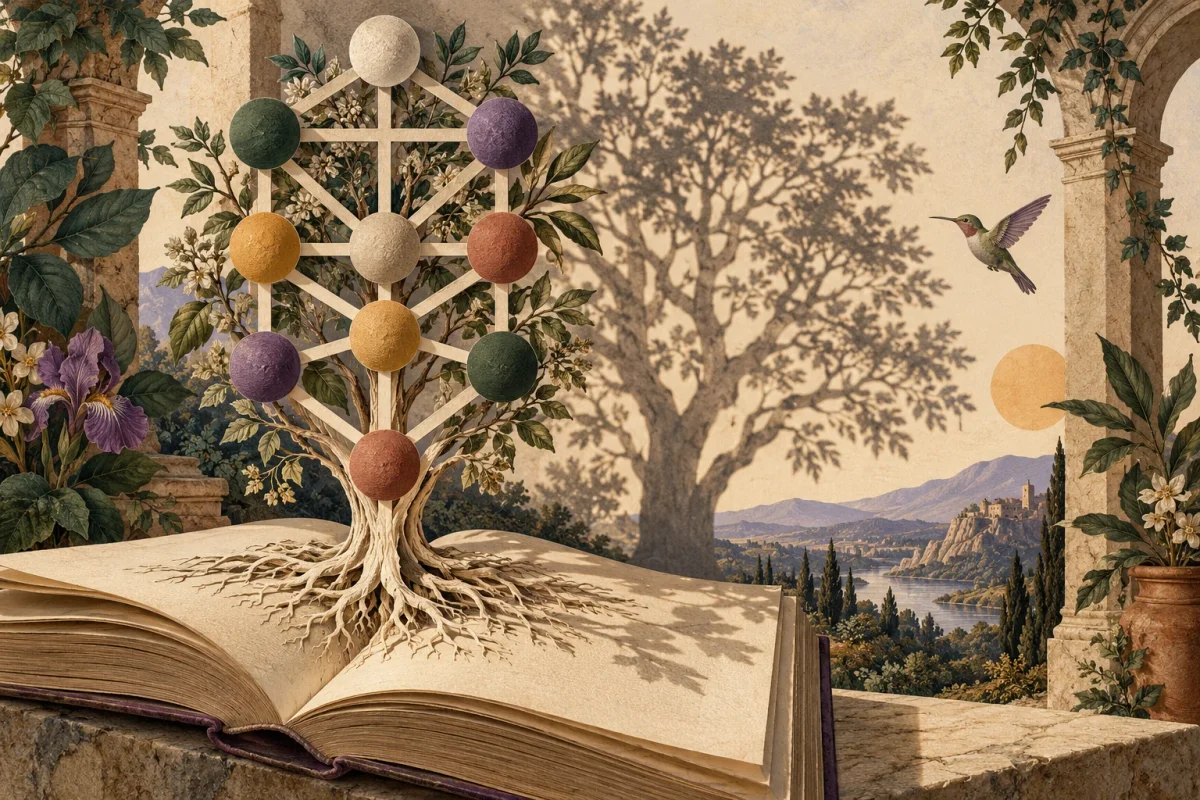
A text is read following a succession. A diagram also offers another possibility: the gaze can rise, return, compare distant points and recognize a relationship before it can be explained. The Kabbalistic tree belongs to this history of visual knowledge.
The Mandragore catalogue of the Bibliothèque nationale de France identifies a sefirot tree in the manuscript Hébreu 763, on folio 35r, connected to a Roman production of 1284. The material data is precious: a symbol that today circulates as an isolated image also has supports, hands, dates and contexts to know. BnF Manuscript Sheet.
Looking at the page returns to the diagram a density that a simple icon loses. It is not enough to recognize ten circles to know what interpretation is written there. The words in and around the figure participate in its function, as does the place of the manuscript in which it appears.
A first gesture of respect is therefore to ask where the image we use comes from. Is it a historical witness, a modern reconstruction, a version related to a particular school? Graphic similarity does not guarantee that each tree says the same thing.
Numbers, letters and routes
A study of Christ Church manuscript 188, Oxford, describes the tree as representing thirty-two ways: ten sefirot and twenty-two letters of the Hebrew alphabet. It also points to the existence of alternative forms of the diagram. Study of the manuscript at Christ Church.
This structure proposes a knowledge for relationships. A point does not just have a definition: it occupies a position relative to others and is reached through a path. The movement of the gaze also becomes part of learning.
We can recognize the fecundity of this form without automatically applying it to each scope. A symbolic tree can help to meditate relationships between unity and multiplicity, reception and manifestation. If we want to describe a biological function or a physical phenomenon, however, we need tools capable of measuring that phenomenon.
The distinction allows for a more interesting dialogue than immediate equivalences. To say that two figures look alike opens up a comparative question. To say that they therefore represent the same universal law concludes the research before having reconstructed the differences.
The map and who looks at it
A spiritual map can perform different functions for different people. For those who belong to a tradition it is also a religious heritage; for a historian it is a document; for an artist it can be a form that generates other thoughts. These perspectives can meet, as long as no one absorbs all the others.
The contemporary reader is often drawn to the promise of an order capable of gathering complexity. It is understandable: a figure seems to hold together what appears to be missing in life. Precisely for this reason it is better to observe whether we are using it to understand or to reassure ourselves.
A reading exercise could start with a precise connection. What changes if we isolate a knot? What information do we lose by deleting a line? They are questions about representation before the universe, and help to see how much an orient form interpretation already leads.
Incompleteness also deserves space. An image can collect many relationships without containing them all. Its value does not depend on the claim to close every experience in a scheme. Instead, it can offer a place from which to formulate better articulated questions.
The tree of life thus remains something to study and cross. Its symbolic strength grows when we also encounter the concrete history of the pages that have guarded it.