Start with the name of the shipment
A plane crosses the ice and finds an unexpected world. The account attributed to Richard E. Byrd has the strength of a threshold: the known landscape opens onto a hidden geography. To investigate it, however, it is necessary to hold together the charm of the image and a concrete question: which document allows the episode to be reconstructed?
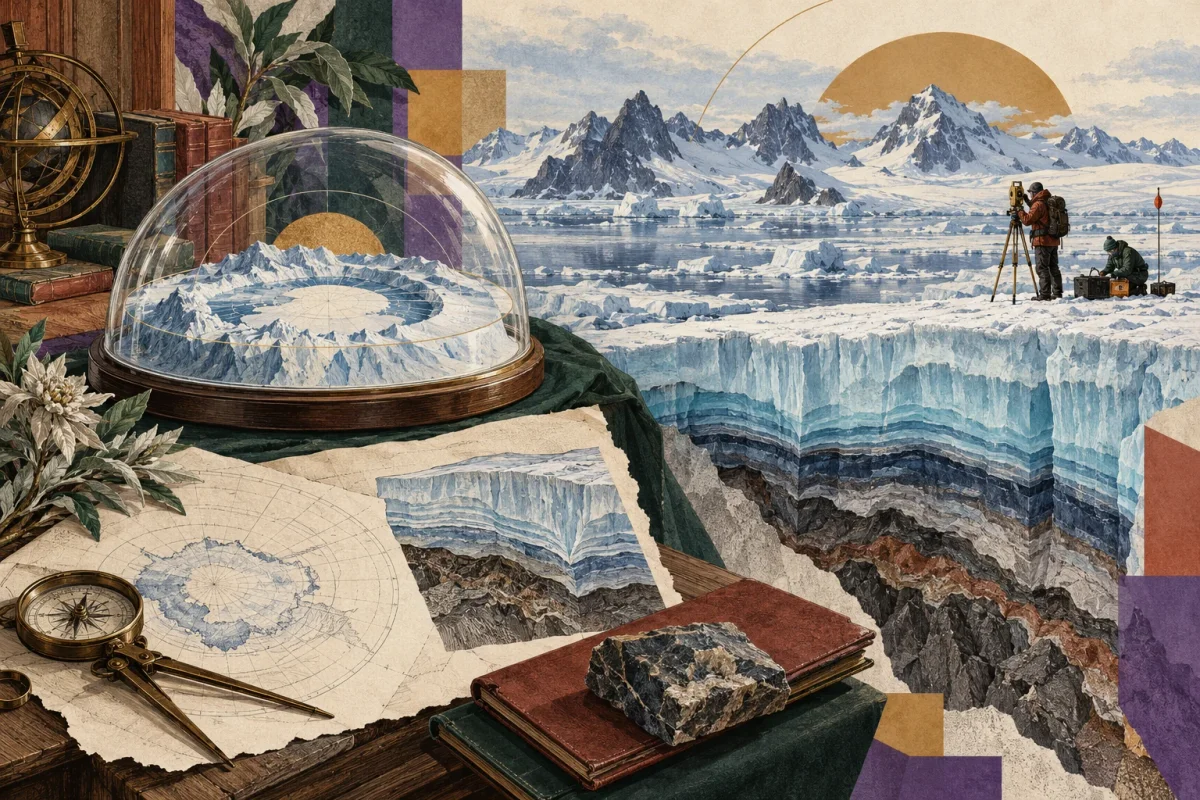
Operation Highjump is a documented expedition from 1946 to 1947. The U.S. National Archives describes the organization, with Byrd as the responsible officer and Richard H. Cruzen at the command of the operational force. The objectives included the Little America IV base, staff training and testing of means in cold conditions. The La archival reconstruction with audiovisual materials It offers a starting point.
The existence of the transaction does not automatically confirm each incident subsequently linked to its name. A historical event can become the frame of stories that possess other sources and other dates. Research must rebuild the link, instead of hiring it.
Distinguishing Poles is also essential. Arctic and Antarctica belong to different exploratory trajectories. Moving a date or place can make documents that relate to different journeys seem connected. Geographic precision comes before conclusion.
A Diary Exists, and Opens Another Discussion
In 1996, Ohio State University announced the discovery, in its archives, of the diary relating to Byrd's 1926 Arctic flight. The communication describes the notebook, its recovery and the debate on the actual achievement of the North Pole. The same object included notes from the 1927 transatlantic flight. This information is available in University report.
It is an identified document, with a material context and a conservation history. This makes it interrogable even when scholars disagree about flight reconstruction. Access to the source does not oblige an immediate agreement; it makes it possible to understand what the comparison is about.
The 1926 notebook cannot be taken as evidence of an entry into the Inner Earth during another expedition. The word diary designates different objects, and each attribution requires its own verification: support, dating, provenance, edition, comparison of the writing or copies.
A text that circulates without such indications remains a source to be identified. Content can be studied as a tale, but uncertainty about its origin limits what we can conclude about the events described. Declare this limit keeps open the possibility of new acquisitions.
The archive doesn't just contain a hero
The Highjump inventory kept at Ohio State includes correspondence, communications, reports, financial documents, and flight materials at the South Pole. I references to boxes and files They return an operation made up of many people and activities, in addition to the figure of the commander.
This plurality is also useful for controlling a surprising hypothesis. A route, time interval, or event can be compared with documents produced by different subjects. The value of the match depends on its independence: many copies of the same story do not become many testimonials.
The absence of a reference alone does not prove that an event is impossible. It is not even enough to prove that the evidence has been concealed. Between these two conclusions there is the work of research: describing what is missing, looking for relevant traces, accepting partial results.
Antarctica retains an imaginative power that documentation does not destroy. An extreme environment puts the orientation in crisis and makes visible how much an expedition depends on tools, cooperation and human limits. It is already a story capable of questioning our position in the world.
The journey inside the sources can become as adventurous as the one inside a map. The question about Byrd remains precise: which object are we reading and which episode can we connect to him? Wonder earns a way when we offer it controllable coordinates.