An Island Within a Philosophical Conversation
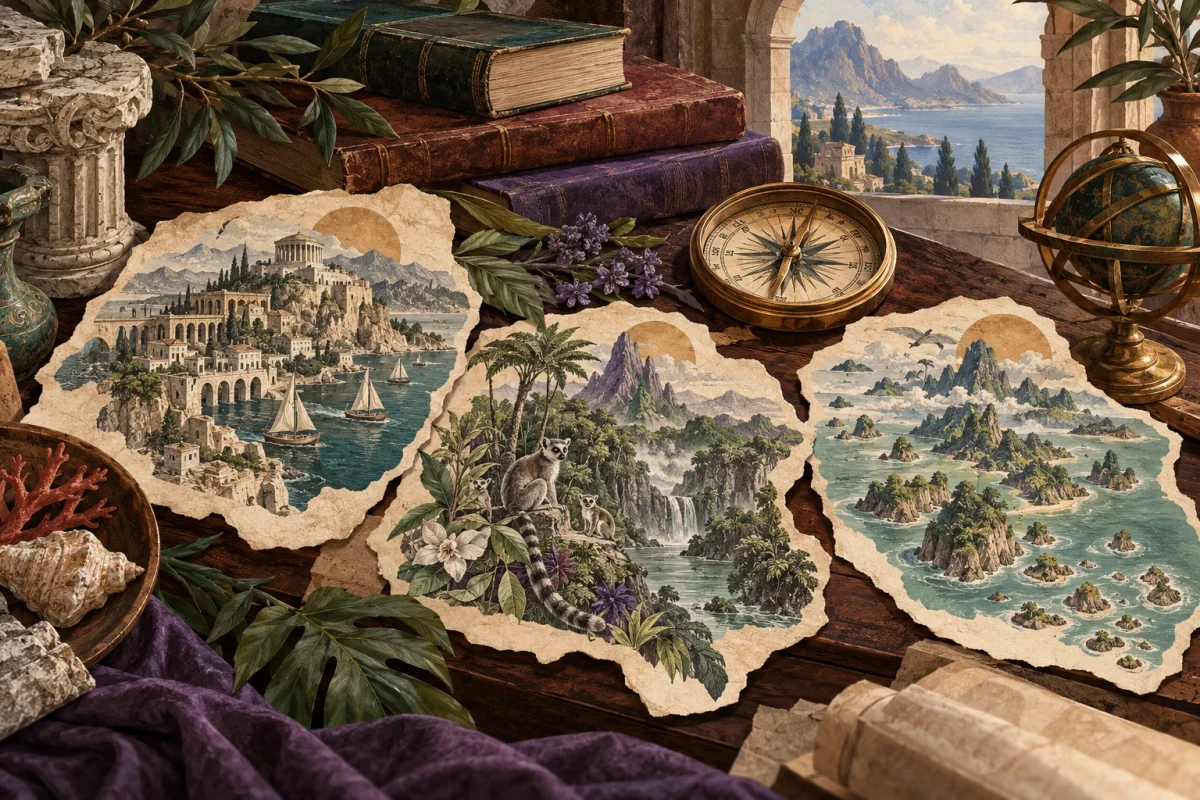
The name of a lost continent seems to promise an answer to the question of origin. Behind the known civilizations we imagine an earlier history, capable of connecting what appears to be separate. Atlantis, Mu and Lemuria are often juxtaposed in this quest, but they are not born from the same document.
Nel Crizia, Plato describes Atlantis through a narrative of gods, descents, organization of space and power. The story presents itself within a philosophical conversation and contains its own chain of transmission. The dialogue text allows you to recognize these steps.
The difference between the story told and the story of the text is decisive. That a character reports an ancient memory documents what happens in the dialogue. Further evidence, independent of narrative construction, would be needed to establish that the same story took place in the world.
The dialogue is interrupted as Zeus is about to speak at the assembly of the gods. This suspension also belongs to the document we possess: a follow-up desired by the reader cannot be treated as a preserved part of the text.
This does not reduce the value of the island. The description of a powerful civilization can question wealth, order, and limit. The lost world offers a distance from which to look at the present one. Its philosophical strength does not entirely depend on the possibility of indicating it on a paper.
Lemuria arises from a question about animals
The history of Lemuria instead leads to nineteenth-century zoology. Philip Lutley Sclater recalls in an 1878 article that he proposed that name in 1864 for an ancient land, hypothesized in the Indian Ocean area to explain reports in the distribution of mammals. It also discusses compatibility difficulties between different reconstructions. It is a direct testimony in his Zoological Distribution Essay.
The name therefore originally belongs to an attempt at naturalistic explanation. Its subsequent use in spiritual cosmologies requires another historical passage. A word can retain the same form as it changes the object it purports to describe.
The distinction avoids a frequent misunderstanding: the existence of a historical scientific proposal does not validate every story that inherits its name. To compare hypotheses one has to ask what data they were trying to explain and with what tools they could be controlled.
The history of knowledge acquires interest right here. Authors formulate models with available materials; difficulties can be recognized and become part of the research. A hypothesis is alive when it also makes it possible to understand where it meets resistance.
Mu and the promise of a common mother
With The Lost Continent of Mu, published in 1926, James Churchward presents a motherland of humanity located in the Pacific. The edition card shows the author's reference to Naacal tablets as the foundation of his own reconstruction. They are verifiable elements in the catalogue of the work.
The reference to a document imposes a further question: is the document identifiable and accessible for comparison? Knowing that a book claims to be based on a source allows one to study its argument. It does not replace verification of the source itself.
The idea of an ordinary mother can express a desire for unity. It can also make too simple cultural differences that possess stories of their own. Similarities between symbols and constructions deserve investigation, but they do not automatically prove a single material origin.
A useful path then joins three levels: what the text affirms, the history of its interpretations, the relevant findings to geography or archaeology. The reader can follow the transformation of an idea without having to choose immediately between total adherence and derision.
Lost continents remain powerful because they also question the present: where do we come from, what have we forgotten, what unity do we seek? Studying the three stories separately allows you to formulate these questions with greater freedom. Each name comes back to having contours, and the imagination meets a ground on which to continue working.