What if the world we consider obvious was only a part of what we can know? It is a question capable of going through a religious text, a personal crisis and a cosmological tale. His strength grows when he questions a habit. His difficulty begins when one answer claims to contain all the others already.
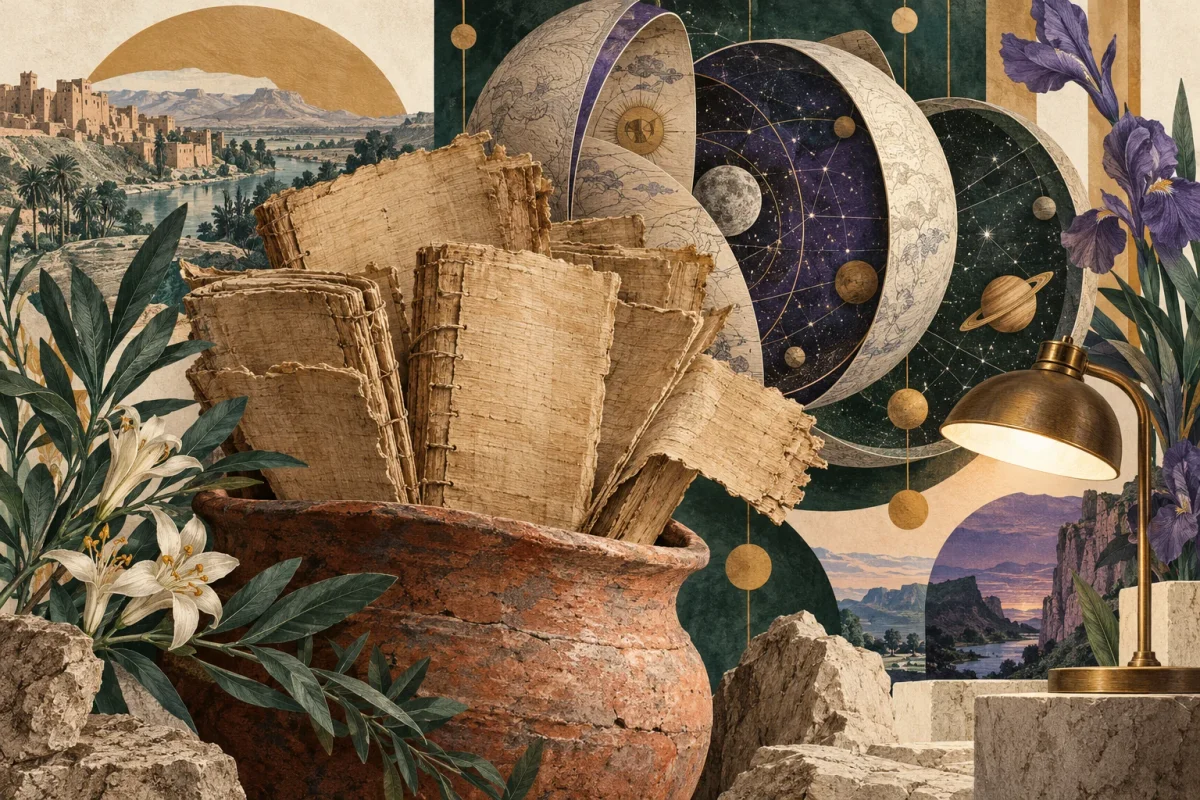
Nag Hammadi's manuscripts offer a concrete place from which to start. They were found in Upper Egypt in 1945; the codes are generally traced back to the 4th century. L’frame published by Brill distinguishes this dating from the more ancient and articulated history of the texts transmitted. A book copied in a century can store compound materials first.
Knowledge That Changes Those Who Read
Nag Hammadi includes different works. It is necessary to open a precise treatise, recognize its title, read who speaks and follow its reasoning. The general label of "gnostic" can orient the reader; the plurality of texts calls for further attention.
Nel Gospel of Thomas, the saying 3 places the kingdom in relation to interiority and externality, tying self-recognition to a condition of knowledge. La Authorized translation by Stevan Davies allows you to read the passage along with the neighboring sayings. The form invites us to seek an interpretation: the phrase does not deliver a geographical map or a scientific concept of consciousness.
The word “awakening” can then indicate a transformation of the gaze. What seemed natural is questioned: the relationship with the origin, the identity received, the value of knowledge. The spiritual question also meets here with a practical responsibility: how does the way of inhabiting relationships change?
A cosmos crossed by powers
L’Apocrypha of John develops a much more articulated cosmology: the invisible Spirit, divine emanations, Sophia, the power of Yaldabaoth and other authorities who rule the world. La translation by Frederik Wisse makes these images accessible and specifies the existence of four Coptic witnesses.
In the account, an authority can ignore its own origin and proclaim itself absolute. Reading this motif as a question about power is an interpretative possibility: what systems claim to exhaust reality? How do we recognize a knowledge that frees with respect to a certainty that imprisons?
The text documents a religious view. The fact that that view is attested in ancient manuscripts establishes its historical existence; its cosmological truth remains a different question, which each research must address by declaring its own criteria.
The modern constellations
Much later works are also arranged around the awakening. Nella Secret Doctrine, published in 1888, Helena Blavatsky constructs an esoteric synthesis on the cosmogony and cycles of existence. The text of the first volume allows you to control his reincarnation processing. The proximity of some themes does not make the work a direct sequel to Egyptian codes.
The King of the World by René Guénon, 1927, instead faces the spiritual center and Agartha. L’digital edition of the Classiques des sciences sociales makes the book searchable. The imagery of the Inner Earth meets here the theme of a hidden initiatory center. Reading the text makes it possible to distinguish imagined geography, symbol and metaphysical statement, following the nuances proposed by the author.
In Kryon's contemporary language, ancient souls, spiritual dimensions, and Pleiadians appear as figures in a cosmic history of humanity. Theofficial archive of 2019 presentations document this content. These are teachings presented as channelings; their publication does not constitute a verification of the extraterrestrial origin of the messages.
Crossing even the most radical assumptions
Contemporary issues include a version of the cycle of incarnations intended as a constraint: consciousness could be held back through powers, lights or presences encountered after death; awakening would also consist in recognizing conditioning and passing it. The theme of the “reincarnation trap” is explicitly present in the material published on David Icke's website.
This hypothesis deserves an examination that preserves its content and reconstructs the sources. The cited page attests to the theme; it does not establish an identity with Blavatsky, with Tibetan traditions or with a certain treatise by Nag Hammadi. A critical path must verify each link, avoiding transforming different stories into a single doctrine.
The journey remains open also to multidimensional cosmologies and the possibility of a broader consciousness of ordinary identity. We can meet them through texts, told experiences and questions. Keeping these differences visible allows the reader to choose how to proceed: compare a step, question an image, ask for a proof. The awakening also begins with the freedom not to confuse these operations.