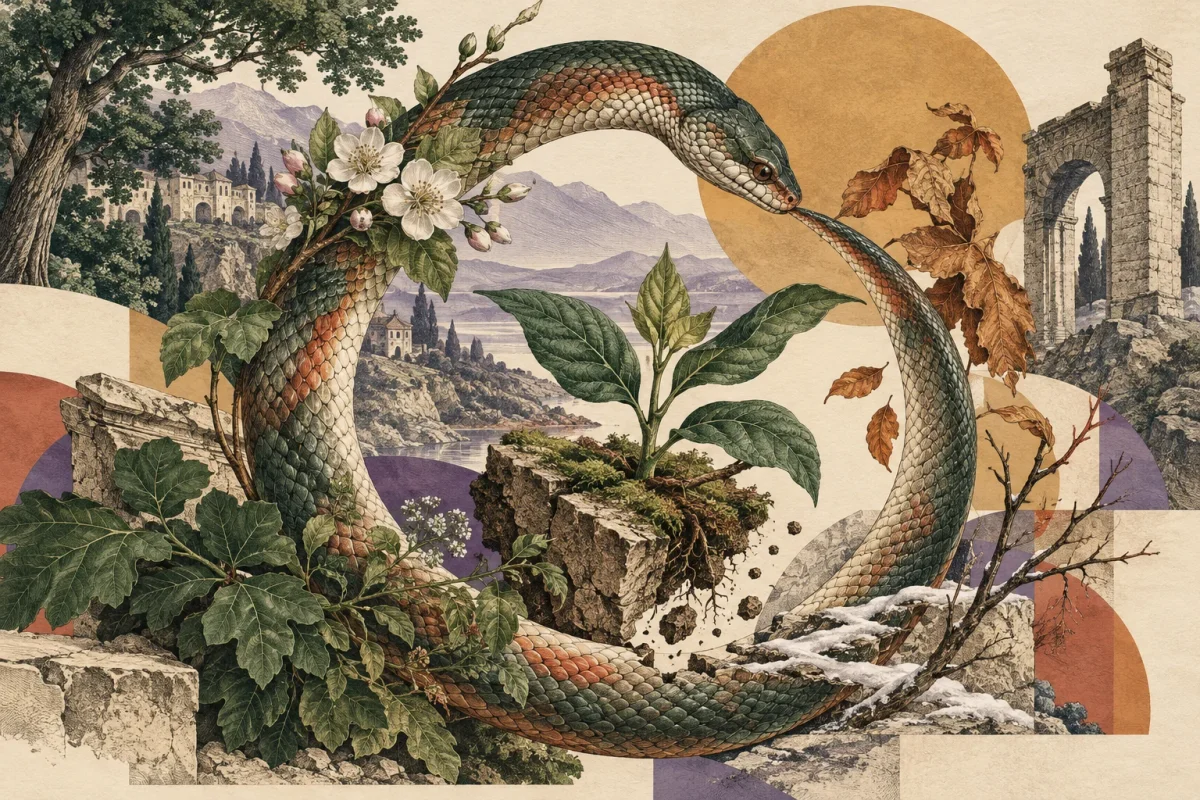
The end of the body meets the mouth. The figure seems to close, but the gesture continues: a snake feeds on what is already part of itself. Ouroboros holds back in a compact form a strain that is difficult to express: wear out and continue, finish and return to the origin.
Its presence in different eras and contexts invites to a precise path. Before giving it universal meaning, we can observe where it appears, what object it inhabits, and what reading the accompanying text proposes.
A figure inside concrete objects
The British Museum preserves a late Roman magical gem, dated between the 4th and 5th centuries, on which a Uroboro encloses a representation of the uterus and other divine figures. La object tab describes material, engravings, conservation status and iconography.
It is an encounter with a material culture. The circular figure occupies a position, delimits a space, comes into relationship with inscriptions and images. The catalogue offers elements to study it; its magical use documents a historical practice, without attesting to the effectiveness of the properties that could be attributed to it.
Much later, in the 1618 edition of theAtalanta fugiens by Michael Maier, a dragon that devours its own tail appears in emblem XIV. Lo Science History Institute Preserves Engraving, attributed to Matthäus Merian in the alchemical volume.
The image is part of a work in which figures, texts and music participate in a search. His reading requires that context. A visual similarity between distant objects may suggest a historical question; the precise connection must be reconstructed through sources and transmissions.
The cycle can transform what returns
Ouroboros also offers a chance for thought in the present. A project can go back to its origins to understand what keeps feeding it. A person can recognize a returning behavior and wonder if they are repeating a habit or going through a transformation.
The circular shape contains both possibilities. A cycle can preserve a necessary continuity: seasons, maintenance, learning. It can also become a circuit that always brings back to the same point, absorbing every experience into a ready-made explanation.
To distinguish the two movements you need to look at the consequences. After a new encounter, did the language become enriched? Could a belief change? Has a mistake changed the practice? Return acquires meaning through what it has made possible.
Using the symbol as a question preserves its complexity. Regeneration can include a loss: leaving a name, a certainty, a form that had worked. The nourishment of the past also requires an ability to transform it.
The Cure of a Living Form
In a cultural activity, starting over sometimes means reviewing how the public can participate. A column becomes an archive, a response opens a new article, a theme changes because other sources have emerged. Identity continues to exist within these passages.
A system that claims to be always evolving must make some real change visible. Otherwise innovation remains a repeated word. The verification can be concrete: what element did we correct, what previously neglected question did we accept, what limit do we finally know how to name?
The image of the serpent does not provide a natural law of consciousness. It offers a form through which to think of the relationship with what we come from. We can contemplate it as a spiritual figure, study it as a historical witness, use it to question an experience.
Its most fruitful point perhaps remains the encounter between mouth and tail: the place where what ends becomes matter of another beginning. We can ask ourselves what we are ready to transform so that the next round is not just the same as the previous one.