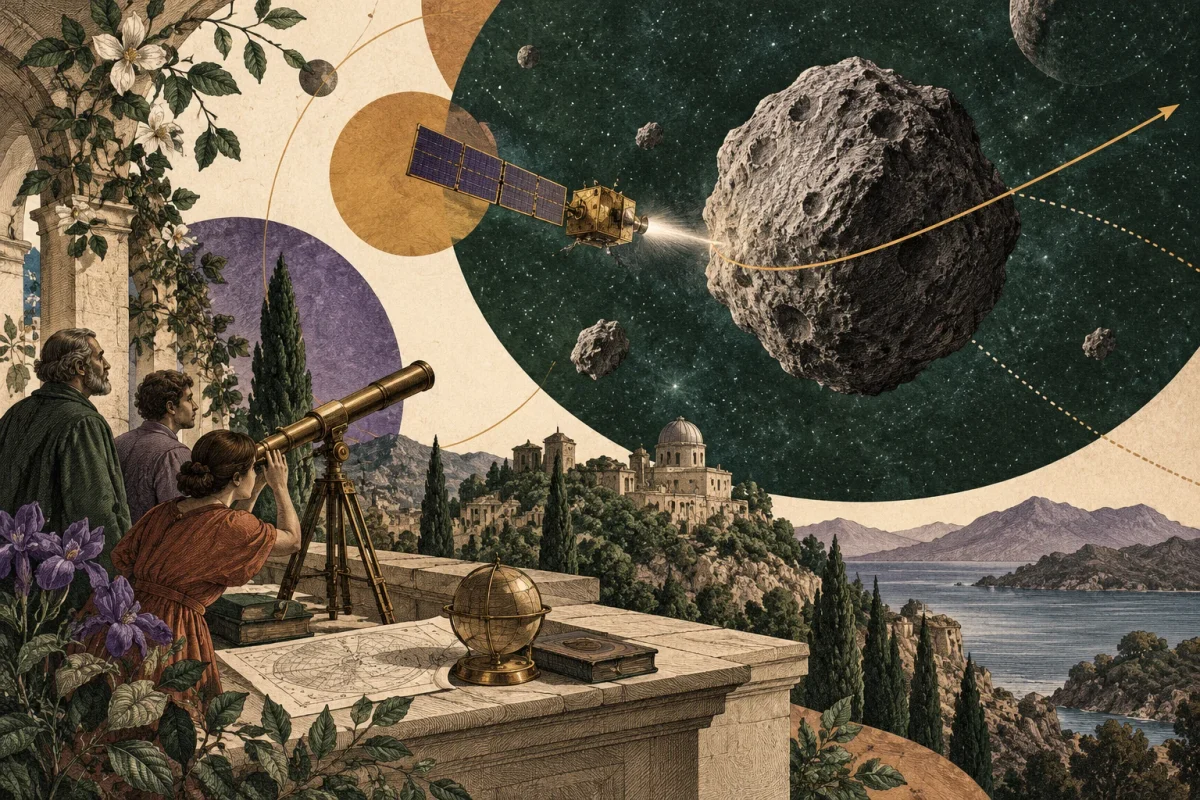
A catastrophic prediction can immobilize us or make us alert. The difference also depends on how it is told: a fate already closed, a possibility to be examined, a call to change conduct. When the future becomes an irrevocable date, the question of what we can do is likely to disappear.
The idea of a participated future goes through many spiritual pursuits: humans would not just be spectators of events. This intuition can be explored on the ethical plane without attributing to thought a proven control of the celestial orbits. Planetary defense offers a concrete example of collective action, by a method different from that of a prophecy.
Distinguishing the Warning from Certainty
A prophecy can be read as a religious text, symbolic vision, received message or literal prediction. These uses do not require the same verification. An image that calls for responsibility is not equivalent to an astronomical calculation; a date presented as a physical event requires controllable evidence instead.
Even a scientific forecast has conditions and margins of uncertainty. Its strength does not consist in never changing, but in being able to be updated when better data arrives. Correcting an estimate does not automatically prove that someone is hiding an already known destiny.
The useful question is therefore: what information could modify this statement? If any outcome is interpreted as confirmation, the story may retain personal significance, but it loses the possibility of being verified as prediction. Declaring this difference makes the discussion more honest.
A modified orbit through measurable intervention
On September 26, 2022, the NASA DART probe struck Dimorphos, the small body orbiting Didymos, to experience the kinetic deviation of an asteroid. The chosen system posed no threat to Earth. Subsequent observations found changes in the orbit and shape of the affected body. NASA, results on orbit and shape change.
The European Hera mission was designed to study in detail the effects of the impact and better understand the technique. Its stated goal is to transform a successful experiment into knowledge that can be used for planetary defense. It is a collaboration between observation, models and field measurements. ESA, Hera mission.
This case does not prove that a collective meditation modifies an asteroid. It shows that a material intervention prepared by many people can change a trajectory and that the result requires subsequent verification. It does not even authorize setting a certain date of impact on Earth or considering any possible risk solved.
Responsibility comes before the emergency: research, tools, comparison of hypotheses, public decisions and the ability to work across national borders.
Participate without the illusion of controlling everything
A large space exists between fatalism and omnipotence. We are not masters of every event, but many consequences depend on the conditions we build: preparation, care of infrastructure, quality of information, willingness to cooperate. An open future is not the promise that everything will be okay. It is the recognition that choices have effects.
Even an inner practice can participate in this space, if it makes us less responsive and more able to act together. His assessment is about what happens in our relationships and decisions. Jumping to a cosmic causality would require further evidence, not just a similarity of language.
We can then read a warning without making a countdown. Asking for sources, understanding uncertainty, and identifying proportionate actions prevents fear from becoming an absolute authority. Shared vulnerability can be a reason for collaboration, instead of a competition to own the most dramatic ad.
The participatory future begins when the question changes: what conditions can we prepare for more life chances? It does not offer a guarantee. It gives us back a task concrete enough to be discussed and open enough to require the input of others.