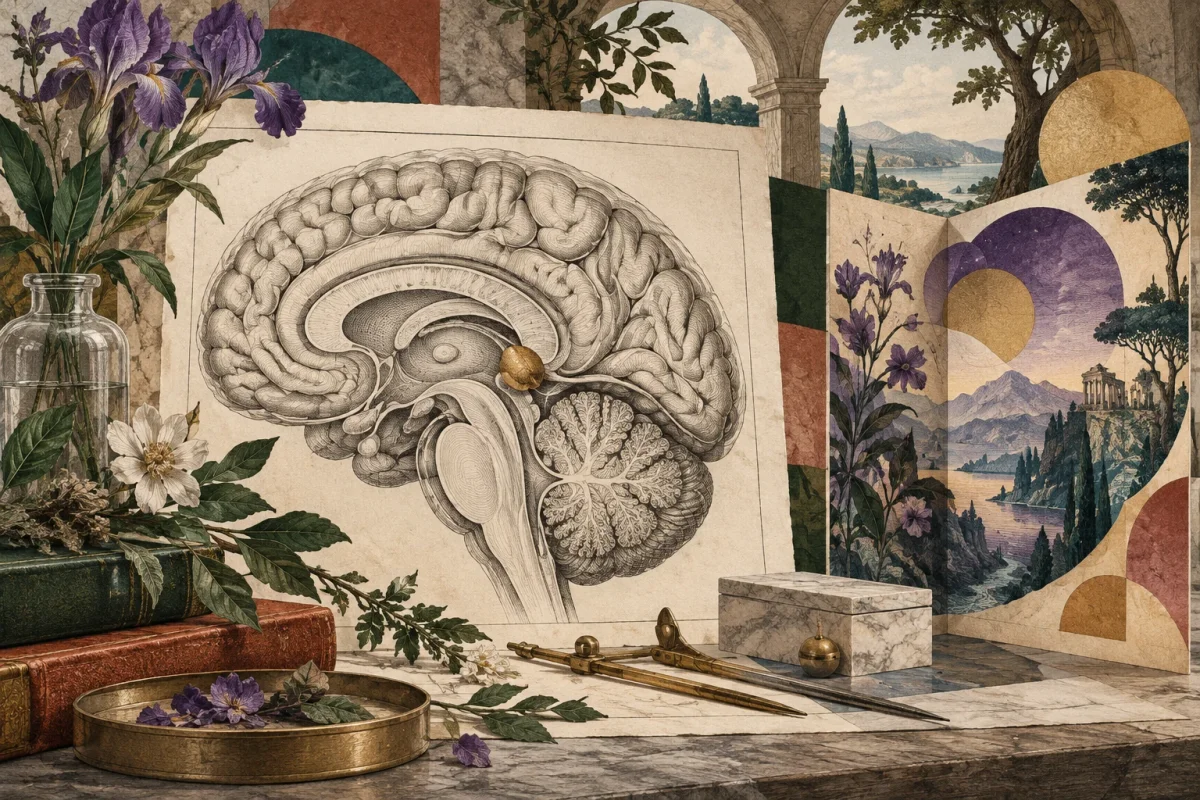
Few organs in the body have collected as many symbolic expectations as the pineal gland. In spiritual narratives it is approached to the third eye, intuition and the possibility of perceiving beyond the visible. In the fluorine debate, however, it becomes the center of an uneasy question: could anything close that faculty?
The application contains different plans. One concerns a biological structure and its processes. Another is about the meaning we attribute to the inner vision. The most delicate point is the transition from one to another: can a storehouse measured in a fabric really prove the loss of a spiritual capacity?
A real function, without the need for a myth
Pineal produces melatonin, a hormone involved in regulating the sleep and wake cycle. It is a recognized function of physiology; the National Cancer Institute summarizes it in its own definition of melatonin. This reference does not automatically transform any nocturnal or intuitive experience into a phenomenon attributable to the gland. NCI definition.
The language of the third eye can have a symbolic function: to describe an ability to understand that does not coincide with just looking. We can explore this meaning as experience and imagination, without claiming that an organ of clairvoyance has been located.
Accuracy does not impoverish the symbol. It gives him freedom, because it does not force him to depend on a biological demonstration that we do not possess. We can question the quality of our perception without turning every sensation into a reading of endocrine functioning.
What the Fluoride Study Observed
In 2001, Jennifer Luke published on Caries Research an analysis of tissues obtained from eleven deceased elderly people. The work measured fluorine in the pineal, muscle and bone and calcium in the pineal. It reported fluoride accumulation in the gland and a correlation between fluoride and pineal calcium. It is a circumscribed observational result, identifiable through the described DOI and protocol. Original study, PMID 11275672.
That design does not measure telepathy, spiritual awakening or closing a third eye. It does not reconstruct on its own the different exposures over a lifetime and does not establish that a particular toothpaste has produced a certain outcome. The observation of an association does not automatically decide the direction of each causal relationship.
These limits are also essential in order not to ignore the result. We can keep it as a useful clue to ask further questions about physiology, without loading it with conclusions that have not been studied. A small historical sample does not represent, alone, all ages and conditions.
To assess a health consequence, exposure, timing, observed functions, and competing factors should be defined. In order to talk about spiritual consciousness it would also be necessary to clarify what experience we mean and how it might be examined. It's different research.
The risk of turning the body into an enemy
The narrative of an inner faculty blocked by a substance can produce a feeling of helplessness: our access to sense would depend on a gland that we imagine to be compromised. It can also fuel the search for purification practices presented as certain, without proper evidence.
We do not propose decalcification protocols, suspensions of care or individual indications on the use of fluorinated products. Health decisions require a person-relevant assessment and exposure, not the machine translation of a spiritual image into a prescription.
However, it remains a legitimate question about the relationship between the environment and the inner life. We may want to learn more about what we are exposed to and, at the same time, recognize that listening to ourselves is not reduced to looking for a perfect fabric. The body does not have to pass a purity test to become worthy of attention.
The pineal can continue to be an object of biological research and a symbolic resonance point. The dialogue between these plans becomes fruitful when it declares its own passages: what has been measured, what is assumed and what, as an image, still invites us to look.