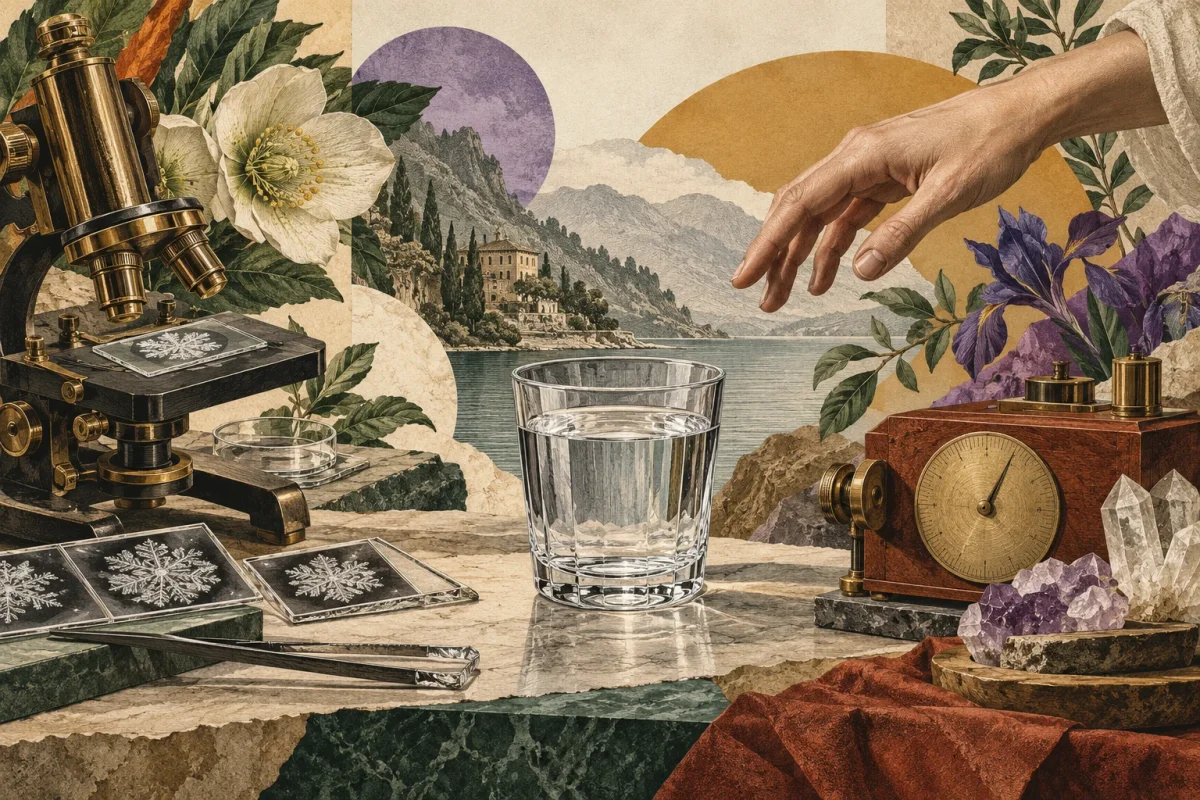
A glass of water, a word, an intention: enough everyday elements to open one of the most radical questions about the relationship between mind and world. If consciousness were not merely a spectator of matter, how could we recognize its action? The issue goes through spiritual practices, radionic devices and experimental attempts, often brought together under the same label even when describing different things.
Taking a question seriously requires preserving its accuracy. We can tell a theory in its most interesting form without transforming a circumscribed result into the demonstration of every connected statement.
Radionics imagines a relationship beyond distance
The Radionic Association presents radionics as a practice that would employ intuitive faculties to detect energy imbalances and intervene even remotely. Describes tools with numeric values, called rates, to which it attaches a mainly symbolic meaning. Its site is a primary source on what this professional tradition supports; it does not, therefore, constitute an independent verification of the declared effectiveness. The description of the association.
In its language, the relationship would not depend only on material contact: a reference to the recipient, a sample or a medium could represent the link. Water is then imagined, in some declinations, as a possible vehicle for intentional information. Describing this picture is not equivalent to identifying an already measured physical signal.
Words such as frequency and energy require an additional question here: do they indicate defined quantities with units and instruments, or a symbolic map? The two uses can have meaning in their respective contexts. Exchanging them, however, makes it impossible to understand which verification is proposed and which result could disprove it.
What the Crystal Experiment Measured
A pilot work published in 2006 by Dean Radin, Gail Hayssen, Masaru Emoto and Takashige Kizu compared water samples to which positive intentions had been directed with control samples. Photographs of the crystals obtained were evaluated blindly for their aesthetic appearance. The authors reported higher scores for the treated group. The initial protocol employed four bottles, two per condition. Original studio, text of work.
The outcome concerns judgments about images. It does not measure healing, potability, elimination of contaminants or clinical benefits. Not all photographs represent completely independent experiments: multiple crystals from the same bottle share a part of their experimental history.
These clarifications do not cancel the reported remark. They describe its scope. It would require explicit protocols, sufficient independent samples, replicas, and image selection criteria defined before the results. An unusual question gains strength when it allows different researchers to understand exactly what they need to repeat.
Guarding meaning without inventing a cure
Paying attention to what we drink can change our experience of the gesture: slowing down, noticing the thirst, remembering the origin of the water. This lived plan is accessible without first having to prove a physical transmission of intention. It can be described as a practice of presence, leaving open and separate the hypothesis of an effect on matter.
The difference becomes decisive when a therapeutic promise appears. A sick person should not be asked to consider a harmonious photograph as evidence that a water cures a pathology. Similarly, a failure to improve does not prove that he thought wrong or believed too little.
Respectful research together protects the freedom of exploration and the vulnerability of people. He does not need to mock what he does not understand, nor to fill every interval with a certainty. He may ask what we know, what experience we are telling and what passage remains to be verified.
The water thus continues to pose a fertile demand. Not because every theory that concerns it is confirmed, but because it obliges us to observe the boundary between the force of a meaning and the proof of an effect.