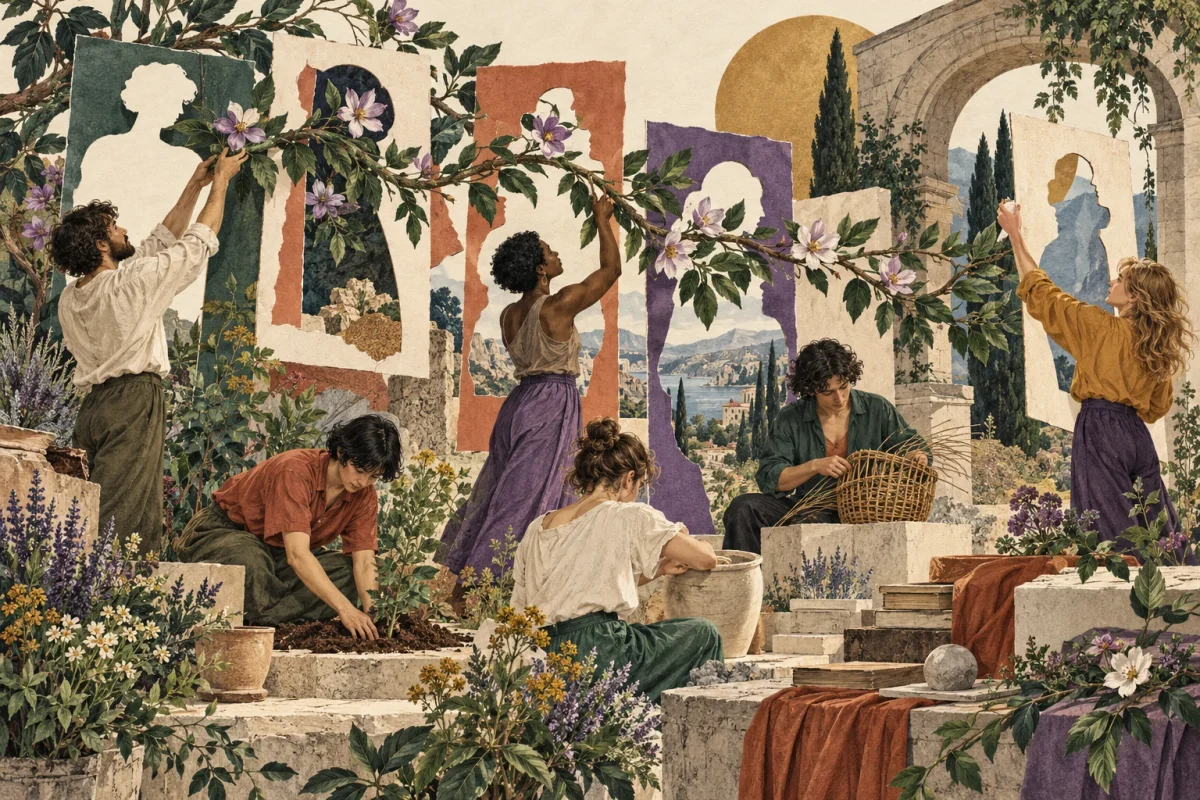
A female figure is chosen to represent the cure. A female voice accompanies a story about the origin. A body becomes the symbol of generation. Each choice can have an evocative force; each also brings a question: how much space does it leave the person beyond the meaning that assigns them?
Talking about feminine generative allows you to explore images of creation, reception and transformation. The work becomes more interesting when it makes visible the transition from symbol to concrete life, where women and men possess different stories and possibilities.
What an Image Allows You to Know
The so-called Venus of Willendorf is a small prehistoric figure that has received numerous interpretations. The Naturhistorisches Museum Vienna distinguishes what can be studied materially from the attributions of meaning: matter, form and circumstances of the find offer data; an overall reading remains discussed.
Caution is also valuable outside archaeology. A female image associated with fertility can talk about the ways in which a community represents life, but it is not enough to reconstruct the social role of all the women in that community.
We can meet a figure as a source of resonance and continue to wonder who gave her the name by which we know her today. The word “Venus,” for example, already bears a comparison with a historical world different from that of the object. The museum itself recalls the limits of all-encompassing interpretations.
Something similar happens in the present whenever an image is called universal. We have to ask ourselves what experiences he can contain and which ones he leaves on the margin.
Generating as a shared possibility
Using the feminine as an image of the generation can open a reflection on the way an idea is born: waiting, listening, still uncertain form, willingness to let it grow. It is a symbolic vocabulary that each can question through their own experience.
Its fruitfulness also depends on the freedom with which it is employed. A woman may wish to create without becoming a mother; a man may recognize himself in care and acceptance; a person may not find in the two categories the language of his own identity. The symbol meets lives that transform it.
In creative work, this openness allows one to observe who receives the task of imagining and who that of organizing. If a symbolic polarity becomes a fixed criterion for assigning roles, it ceases to be a question and begins to govern opportunities.
Making the language explicit helps to see the passage. Are we describing a quality that has emerged in a person, or are we expecting it from you because it belongs to a gender?
Communication is measured in roles
The Unstereotype Alliance, an initiative convened by UN Women with the advertising sector, proposes principles to represent people as subjects with initiative, avoid objectification and show multidimensional personalities. The code published by the alliance makes these commitments explicit.
We can use those questions in front of a campaign or a movie. Does the woman only speak or lend her face? Do you make a decision or do you confirm someone else's? Do you have recognizable expertise? Are you allowed to appear serious, uncertain, elderly, authoritative, without losing your legitimacy in the scene?
The variety of performances also frees the male figure from a restricted repertoire of power, control and success. Care can become action, authority can live with listening, beauty can find forms other than constant availability at will.
A research on the feminine generative thus acquires a concrete result: to return to look at who we are in front of. The person can recognize themselves in the symbol, discuss it, change it or let it go. It is in this possibility that an image continues to generate meaning.