The God of Waters and Intelligence
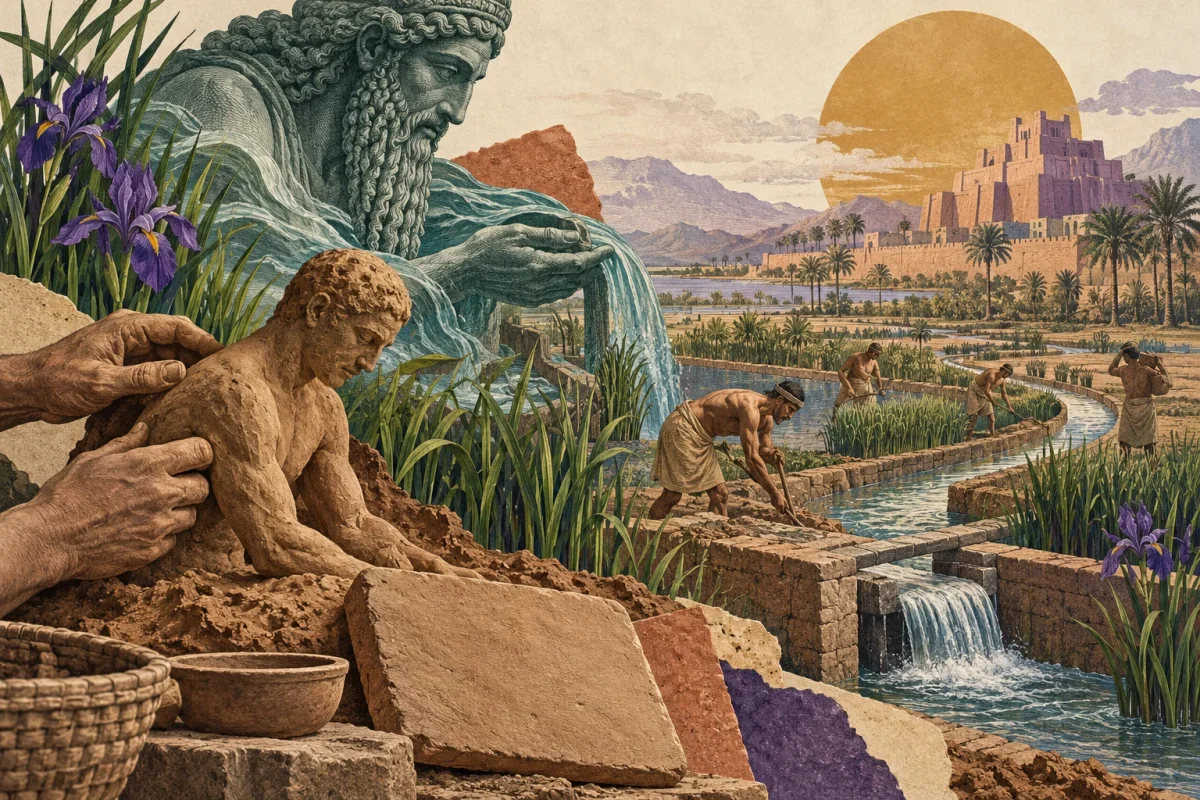
A god capable of listening, devising solutions and finding passages where others see only one order to impose. This image offers an entrance door to Enki, called Ea in the Akkadian tradition. His figure crosses deep waters, wisdom, arts and human protection. The University of Pennsylvania board dedicated to the god reconstructs these associations and the different narratives in which it appears. It is a specialist reference on ancient sources.
The name change recalls that Mesopotamia does not speak with one voice. Languages, cities, and traditions overlap. Before asking what secret a story hides, it is best to ask which text we are reading, in which language and through which translation. Precision makes a deeper curiosity possible.
Even the name of a god can attract very different contemporary interpretations. Its charm stems from the ability to connect dimensions that today we tend to separate: water and thought, technical knowledge and the origin of life, cunning and care. This link deserves attention already on the plane of the symbol, without the need to immediately turn it into a technological chronicle.
Born to Suffer a Toil
In the Sumerian poem Enki and Ninmah, the gods engaged in work complain. The problem of fatigue precedes human creation. Namma turns to Enki; the project takes shape through clay, deities and birth. The human being enters a world where the burden of labor must be redistributed. La Translation of Oxford's Electronic Text Corpus of Sumerian Literature allows you to follow the story directly, including the gaps in the tablets.
The text continues with a creative contention between Enki and Ninmah. Different bodies test the possibility of finding a place in the world, a livelihood, a destiny. Creation thus also becomes a problem of the organization of life: what happens to those who do not correspond to an expected form?
Reading this sequence today opens up questions about work and belonging. Does a society measure the value of people only by the ability to support a function? Who assigns roles, and who can edit them? These are our own questions, prompted by an ancient text. Declaring this distance allows the ages to dialogue without attributing to the authors intentions that we cannot know.
Myth does not deliver an administrative solution. It stages addiction, invention, limits and responsibilities. The power of storytelling also consists in making visible the conflict from which a seemingly natural order arises.
When the present rewrites the origin
The modern re-readings that describe Ea as the protagonist of extraterrestrial interventions or a biological design of humanity constitute an additional narrative level. To evaluate them you have to indicate the steps of the tablets and show how the translation supports those conclusions. The presence of clay, gods, and creation alone does not document genetic engineering, space travel, or extraterrestrial gold mining.
This comparison can become an exciting inquiry: alongside an ancient word, its translation and the contemporary transformation of its meaning. The reader would see where the document ends and where an interpretive proposal begins, retaining the possibility of discussing it.
Gaps also have value. A missing fragment invites research, but does not authorize any completion. Accepting a vacuum means letting the past stand up to our expectations. Ea then continues to ask a living question: what intelligence is needed to inhabit a world in which creating involves taking care of what comes to light?