Before you listen, look at a page
A chorus bursts in and seems to set in motion a force larger than the individual voices. The sound image of Carmina Burana is so recognizable that it can precede the knowledge of the text. But the title leads to two different objects: a medieval collection and a twentieth-century composition. Separating its stories allows us to understand how a work transforms what it receives.
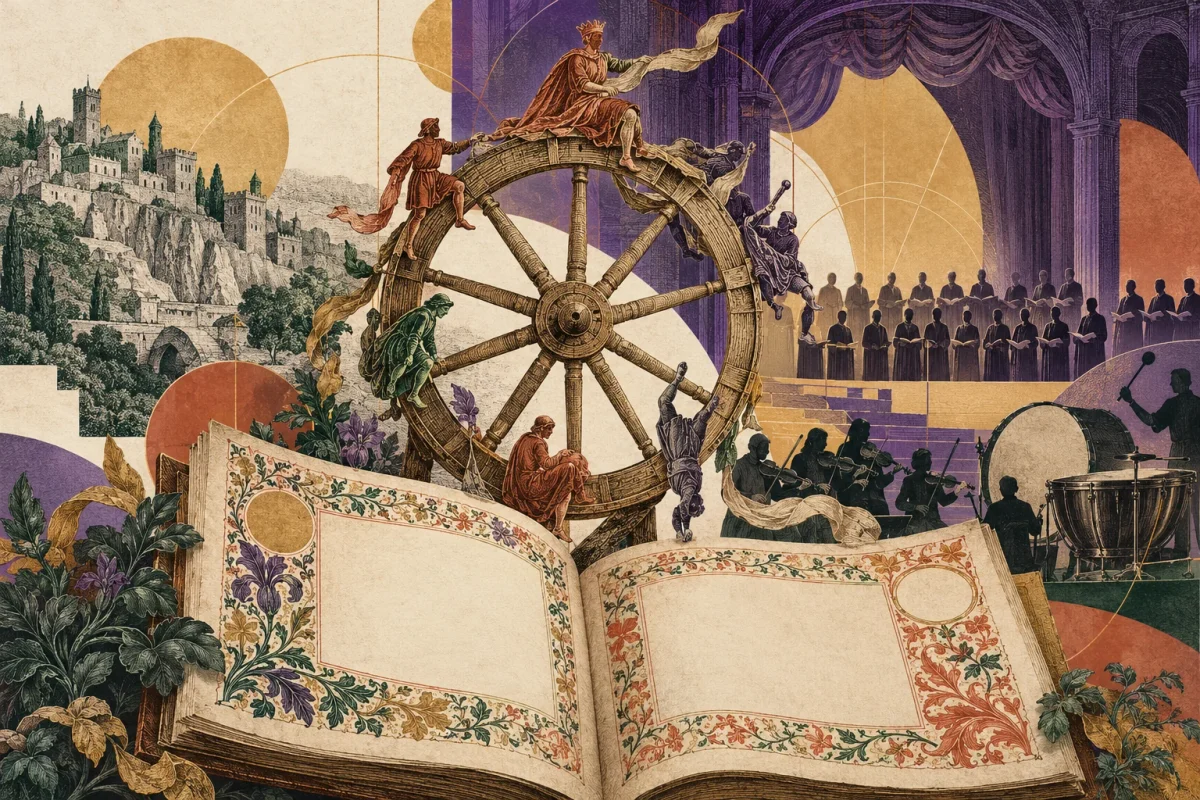
The Bayerische Staatsbibliothek keeps the manuscript Clm 4660, digitized and searchable. The description places it in the southern Alpine context around 1230 and distinguishes a succession of moral and satirical poems, love songs, texts on drinking and play, religious dramas. Some songs have a musical notation in neumi. It is data obtained from material witness card.
Variety is already news. A Middle Ages imagined as a single discipline of renunciation here leaves room for desire, criticism and celebration. The manuscript does not represent every entry of the time, but prevents it from being reduced to a single image. Its plurality survives inside an object that we can still browse through.
The order of the texts also counts. A collection is not just a container: it combines experiences and suggests passages. Satire, love, and spirituality can share a library without becoming the same thing. The reader encounters a world capable of harboring tensions.
The scene of the twentieth century
Carl Orff composed his own Carmina Burana between 1934 and 1936. The first performance was held in Frankfurt on 8 June 1937. The Orff-Zentrum describes the opera as a stage cantata for soloists, choirs and orchestra, part of the triptych Triumphs. The subtitle brings together song, instruments and images: the original horizon includes the scene. La documentation of the centre dedicated to the composer allows you to specify it.
The relationship with the manuscript is therefore a creative choice. A music of the twentieth century interprets words from another time. To confuse the two origins would cause one to lose the very job through which a legacy becomes present: selection, editing, rhythm, distribution of voices.
In listening, chorality can produce an impression of community. Many people participate in the same sound form, while maintaining different parts. Unity comes from an organization: mutual listening, entrances, expectations, relationships between intensity and breath are needed. The collective power also possesses a concrete discipline.
This experience opens up a broader question. When does a common voice expand what we can express? When does it make it hard to feel a difference? The same choral energy can accommodate or overwhelm. To understand it, it is necessary to observe how the relationship between the part and the whole is built.
Luck, Desire, and Responsibility
Luck fascinates because it exposes the precariousness of what we believe acquired. Success does not guarantee continuity; possession does not eliminate the possibility of loss. His movement undermines the presumption of governing every outcome of life.
From here, different answers can arise. A fatalist reading sees every action already absorbed by fate. A more interrogative reading asks how to act knowing not to control everything. Uncertainty can teach attention to the conditions of others: the role we occupy today does not constitute an eternal quality of our person.
The body also intervenes in this reflection. Desire, pleasure, frailty and celebration recall that existence exceeds calculation. They do not have to become a universal morality. Instead, they can prevent a description of life from forgetting what makes it lived.
Returning to the lyrics after the musical impact thus changes the listening. We can recognize words, question their context, observe how composition has transformed them. The strength of the work gains depth when surprise is accompanied by knowledge.
I Carmina Burana continue to circulate because they allow different meetings: with an ancient page, a stage construction, a choir, a question about fate. Each meeting calls for participation. No one relieves us of the responsibility to shape the life that happens in the meantime.