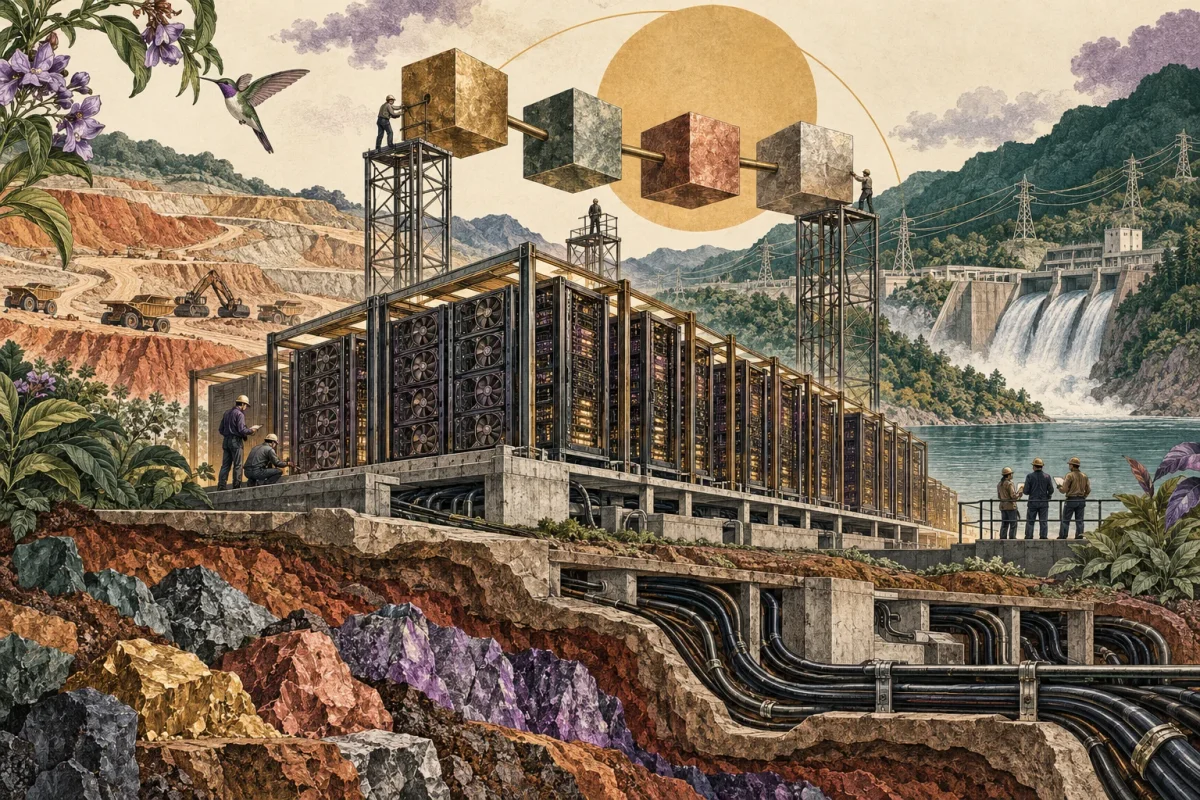
Can we transfer a digital asset without relying on a single central register? Bitcoin arises around this question. But as soon as the talk shifts to cryptocurrencies, the technical project is often swallowed up by two opposing images: limitless wealth or meaningless waste. Both leave little room to understand what is really being produced.
Mining does not extract a substance hidden in the computer. Participates in building a shared transaction history according to certain rules. To do so, it employs equipment, electricity and economic organization. The subject of the investigation is this interweaving, not a price prediction or investment proposal.
What is the use of consuming calculus
Bitcoin's technical documentation describes a chain of blocks in which changing the past requires you to redo the work linked to subsequent blocks. La proof of work uses computational attempts that are difficult to produce and relatively simple to verify. Expenditure is not an accidental effect of a bad interface: it is part of the mechanism by which the system makes the alteration of its history onerous. Bitcoin Technical Guide.
This explains the technical function, but does not automatically decide whether the cost is socially justified. A property can be useful to those who want a change-resistant register and be unconvincing to those who compare other payment systems. Judgment requires declaring which features we consider important and which alternatives we are examining.
It is also necessary to distinguish Bitcoin from the entire category of cryptocurrencies. Different consent rules involve different structures. Attributing to each project the same relationship between energy and security means discussing a general word instead of individual systems.
Estimates have assumptions, not just figures
The Cambridge Bitcoin Electricity Consumption Index builds estimates of network consumption based on assumptions about equipment, profitability, and electrical costs. It presents intervals and a central estimate because the world infrastructure is not observable through a single meter. Its figures should be read with this methodology, distinguishing estimated instantaneous power and annualized consumption. Cambridge Methodology.
The transparency of the method is worth more than a comparison chosen only to strike. Comparing a network with a country can offer an order of magnitude; it does not describe alone emissions, geographical distribution, the origin of electricity or the utility of the service. Also dividing an overall consumption by the number of transactions requires caution: the work of the network supports its security mechanism and does not simply coincide with the separate processing of each payment.
We must therefore formulate more precise questions. Who bears the cost? What territories host the activities? What data are measured and what inferred? A system that promises autonomy should tolerate these verifications without turning them into an attack on its identity.
Energy, scarcity and trust are not synonymous
Spending energy is not enough to create value. We can consume many resources by producing something that no one wants; we can offer a valuable service at a relatively low cost. In the digital world, scarcity can be defined by shared rules, but people's willingness to value it remains a social relationship.
Here you meet a broader question about money. Do we trust an institution, a protocol, a community of users, or the possibility of reselling? Answers can coexist in the same person. Recognizing them helps to distinguish interest in a technology, desire for independence, and expectation of gain.
The possibility of avoiding an intermediary does not eliminate any concentration: infrastructure, skills and access to resources continue to count. For this reason decentralization must be observed in its different levels, without treating it as a definitive seal.
The search for a more conscious economy does not require consecrating or demonizing mining. It requires that the language of value return to include what we support together: security, the ability to participate, resources employed, and accountability to those who do not appear in the transaction log.