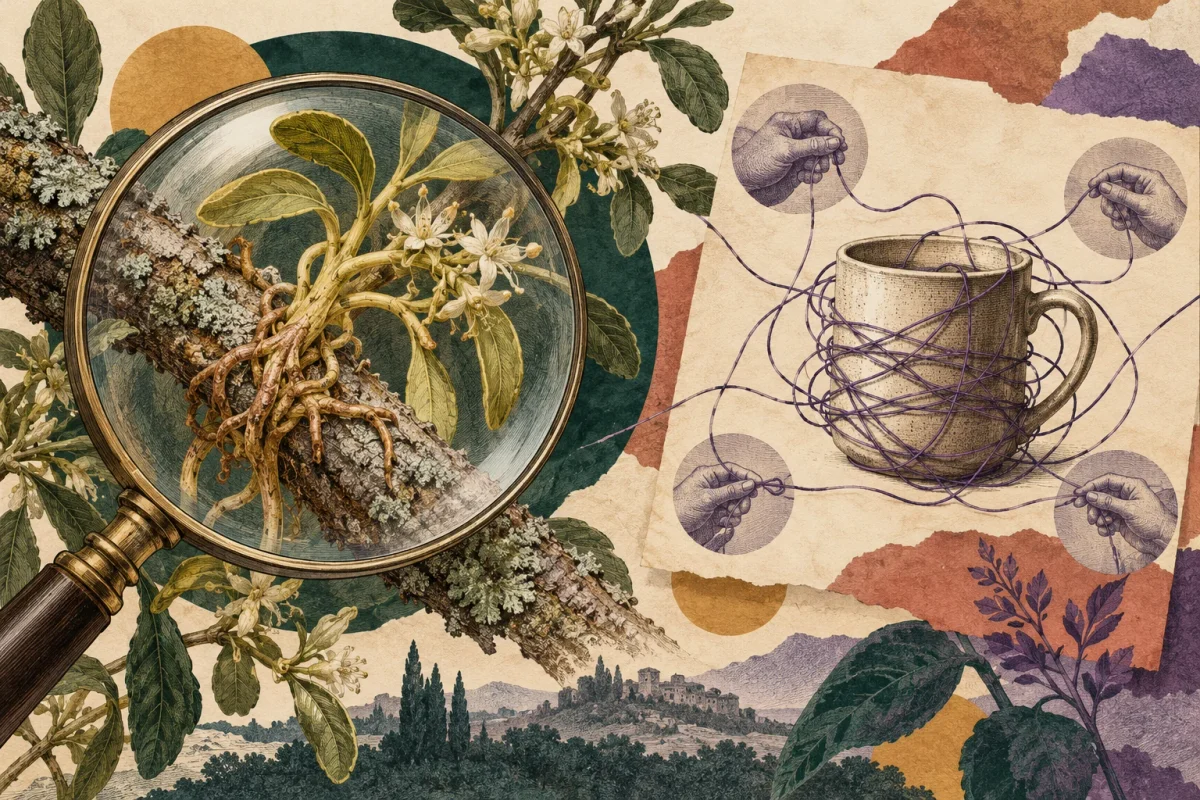
In front of a tree we can look at the phone, recognize a species or stay for a few minutes without looking for a utility. The place is the same, but it changes the quality of the meeting. To consider him an interlocutor means first of all to modify our behavior: to give attention to a presence that does not respond through human language.
Hence a spiritual question arises: can we relate to a form of consciousness other than our own? It is a perspective to be explored without presenting it as a conclusion already reached by biology. Inner experience and plant research can meet while keeping the questions they seek answers to recognizable.
A forest is not a collection of objects
The idea of an isolated organism, locked within its own boundaries, becomes complicated when we observe ecological relationships. Soil, fungi, roots, water and light participate in the life of a plant. To understand the forest it is therefore necessary to study processes that cross multiple beings and environmental conditions.
An experiment published by Suzanne Simard and colleagues in Nature in 1997 used isotopic markings to study carbon exchanges between birch and Douglas fir in the field. It detected two-way transfers under the conditions examined, interpreted primarily through fungal connections. It is a result on measurable materials and relationships, with a defined experimental context. Nature, original study.
The discovery of a connection does not entitle us to translate it immediately into human intentions. To evaluate words such as help, preference or decision we need to clarify what behaviors we observe and what interpretations we add to them. Even a suggestive metaphor can become an obstacle if it hides these differences.
The search remains open even when it fascinates
In 2023 Justine Karst, Melanie Jones and Jason Hoeksema examined some widespread claims about mycorrhizal networks. Their analysis signals more extensive generalizations and interpretations of the available evidence, especially on the preferential transfer to descent and the benefits attributed to networks in each forest. Nature Ecology & Evolution, evidence analysis.
This comparison is part of the work of knowledge. One result generates new questions; another research assesses whether the proposed explanation also holds elsewhere. We can appreciate the complexity of plant relationships without turning a single reading into a definitive account of the forest.
The consciousness of plants then requires a definition of their own. A carbon transfer does not, alone, document a subjective experience. Similarly, the value of a spiritual relationship with a tree does not depend on being able to present it as a laboratory discovery. Its meaning can be discussed from how it directs the attention and responsibility of those who live it.
Listening Begins with the Watcher
We can propose a simple encounter with nature as a cultural opportunity: to observe what we normally go through in a hurry. The bark, the movement of the leaves, the animals present and the shape of the shadow make perceptible relationships that the word tree sums up too quickly.
There is no need to attribute one verbal response to the other to recognize that our presence may become less invasive. If we begin to consider ourselves as guests of an environment, we can ask ourselves what traces we leave and how much space we give to the beings who inhabit it. This ethical consequence is already concrete.
The tree as an interlocutor then remains a living question, open between philosophy, spirituality and observation. It invites us to learn more about what is before us and to distinguish what we hear from what we know how to demonstrate. Attention grows precisely through this willingness to meet a difference.